Mental Health
Ibogaine treatment for PTSD
The strongest results anywhere in the ibogaine literature, and the caveats that come with them. Thirty veterans, an 88% drop in PTSD symptoms, and no control group.
The veterans data, straight
In the Stanford MISTIC study, thirty US Special Operations Forces veterans received a single magnesium-ibogaine treatment. One month later their PTSD symptoms had fallen 88% on average, with 100% response and 86% remission, and suicidal ideation had dropped from 47% of the group to 7%.⁴² What that does not prove: open-label, no control group, all men, magnesium given alongside, so ibogaine cannot take sole credit.
The brain evidence is what makes the numbers hard to dismiss. Cortical thickness rose in 11 of 13 measured regions and predicted brain age fell 1.6 years,⁴³ brain rhythms and networks shifted in step with recovery,⁴⁴ ⁴⁵ and thinking sharpened rather than dulled.⁴² A separate 86-veteran program in Mexico saw improvements holding at six months, though a second compound was given there too.⁴⁶
Add it up honestly: about a hundred and sixteen people, all male veterans, no controlled trial anywhere. Ibogaine is not an established PTSD treatment, and we will not call it one. Treatment is natural ibogaine treatment led by spiritual guides and iboga facilitators, with a registered nurse and a physician on hand. Cardiac screening comes first, with real preparation and integration around it, because trauma work can surface hard material.
The best numbers in the ibogaine literature
average drop in PTSD symptoms one month after magnesium-ibogaine in the Stanford veterans study.⁴²
response rate: every one of the thirty veterans improved, and 86% reached remission.⁴²
measured brain regions showed increased cortical thickness within a week of treatment.⁴³
the drop in predicted brain age one month after treatment.⁴³
Thirty men, open-label, no control group, magnesium given alongside. The best numbers ibogaine has produced, and still not proof.
Years of processing in one night, said carefully
The numbers above measure the change. They do not describe what changing felt like, and for trauma that is the heart of it. When Stanford researchers analyzed how their veterans described the night, they characterized it as a compressed form of therapeutic processing inside a single treatment: trauma-related material surfacing, being witnessed, and in many cases resolving, with real shifts in how the men experienced themselves.¹¹⁶ These were people who had spent years in treatments that never reached the material. The dream reached it in hours.
What veterans describe is not a replay of the trauma. It is seeing a whole life from above: watching the events that broke them with enough distance to feel grief instead of terror, and meaning instead of blame. In the same study, the depth of the mystical dimension of the experience significantly predicted how much PTSD improvement followed.⁴² Read that again, because it is the study's own data saying what we believe: the experience is not a side effect of the medicine. It is part of the medicine, and the mind, not just the brain, is where the healing happens.
Carry the warning with the promise. Surfacing trauma is not gentle, the night is often harrowing,¹¹⁵ and hard material can echo for weeks afterward. That is exactly why preparation and integration are structural here, not add-ons. Rebirth is a big word. The veterans use it anyway, and after watching people walk out of that room, so do we.


A safe place to put the weight down
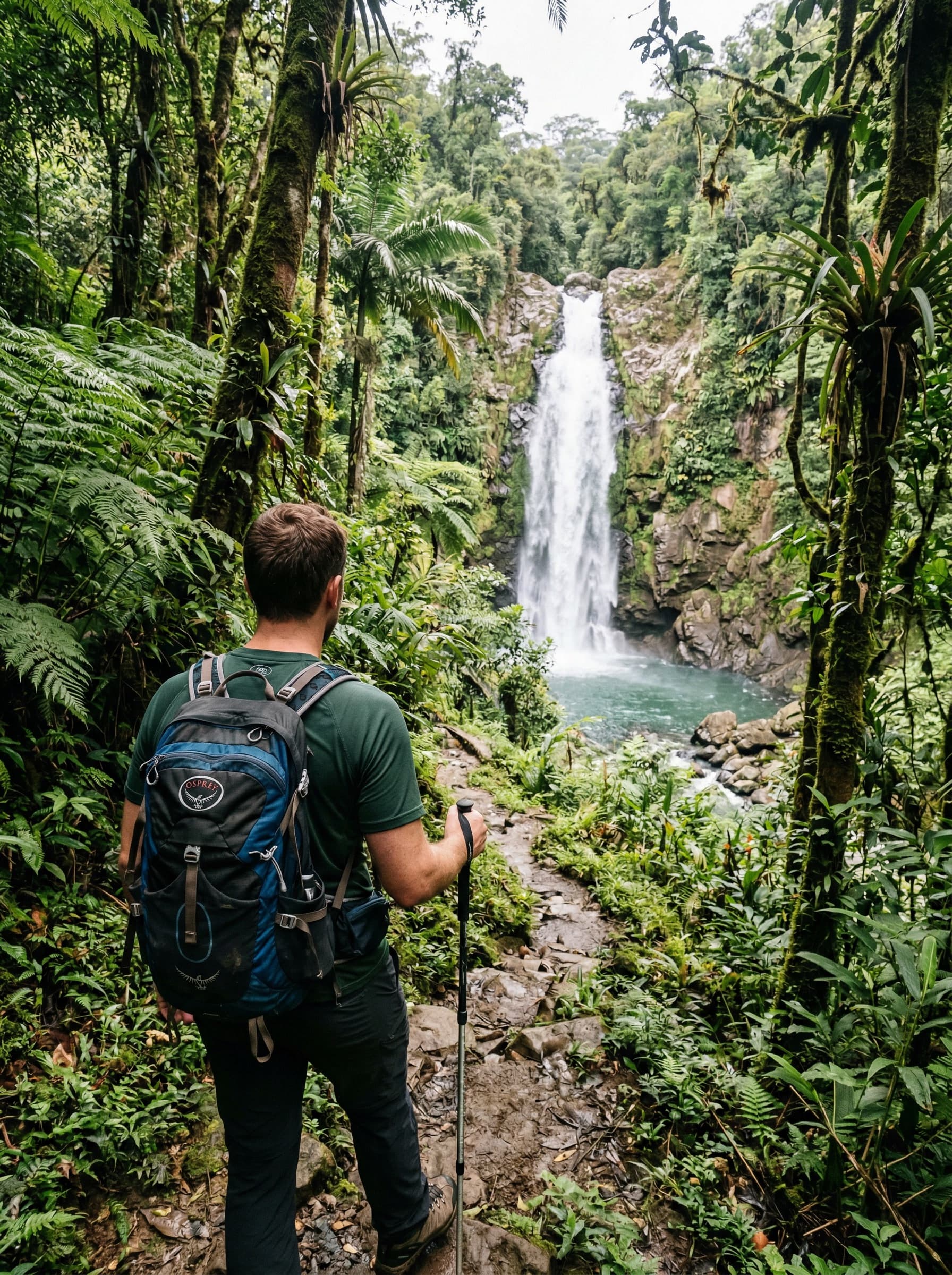
Trauma work needs ground that feels safe. Ours is a rainforest campus above Paraty: gardens, water, quiet rooms, and people who do not flinch at heavy stories.

Trauma at national scale
PTSD is usually framed as a military condition, and the veteran numbers justify it: nearly a third of post-9/11 veterans will meet criteria at some point.¹⁰¹ But most PTSD in America is civilian. Among people who report rape, 45% of women and 65% of men developed PTSD, the highest rate of any trauma ever studied.¹⁰²
The cost of leaving it untreated is not abstract. More than six thousand US veterans die by suicide each year,¹⁰³ and thirteen million Americans are living with PTSD right now.¹⁰⁰ Standard treatments help many of them; a stubborn fraction get no relief from anything currently offered.
That fraction is why special-operations veterans started flying to other countries for ibogaine, and why researchers followed them there with rating scales and MRI machines. The data on this page exists because people ran out of sanctioned options and refused to stop looking.


Many people think PTSD is an inability to process trauma, or the experience of trauma itself being too overwhelming. This may be true. But it is also true that you can reform that trauma into something triumphant.
Psychedelics are a fantastic tool for this. But you must also dive deep into your personal beliefs and philosophy before you can truly begin to understand that the world, and your life history, is not your enemy. It is your greatest teacher.
Charles D. Johnston & Tatiana Aya Tupinambá, Co-Founders, Nekawa
The veterans are moving the world
No condition has done more to bring ibogaine out of the shadows than PTSD. When Medal of Honor recipients and special-operations veterans say publicly that a single treatment gave them their lives back, policy listens in a way it never did for anyone else.
It is listening now. In April 2026 a US executive order directed the FDA to prioritize review of psychedelic medicines, named ibogaine specifically, and put $50 million behind the effort,⁸⁰ with veteran outcomes cited as a central reason. The controlled trials this page keeps asking for are closer than they have ever been.
If they confirm even part of the open-label signal, the shape of trauma care changes worldwide: not a lifetime of managing symptoms, but a supervised reset followed by the long, human work of integration. That second part is not optional, and it is most of what we do.
Citations (12)
[42] Cherian K, Keynan J, Anker L, Faerman A, Brown R, Shamma A, Keynan O, Coetzee J, Batail JM, Phillips A, Bassano N, Sahlem G, Inzunza J, Millar T, Dickinson J, Rolle C, Keller J, Adamson M, Kratter I, Williams N (2024). Magnesium-ibogaine therapy in veterans with traumatic brain injuries. Nature Medicine, 30, 373–381. Read the source →
The MISTIC trial. 30 male US Special Operations Forces veterans with predominantly mild traumatic brain injury received intravenous magnesium plus oral ibogaine (mean 12.1 mg/kg); 23 met criteria for PTSD at baseline. One month after treatment the group had moved from mild-to-moderate disability to no disability on the WHODAS-2.0 (30.2 to 5.1, d = 2.20), the study primary outcome. PTSD symptoms fell 88% on average, with a 100% response rate and 86% remission (d = 2.54); depression fell 87% (83% remission) and anxiety 81% (83% remission). Suicidal ideation fell from 47% at baseline to 7% at one month. Participants also gained in processing speed, executive function, verbal fluency and verbal learning, with no cognitive decline on any measure, and there were no serious or unexpected treatment-emergent adverse events. Open-label and uncontrolled, in a highly selected cohort, with magnesium co-administered, so the effect cannot be attributed to ibogaine alone.
[43] Adamson M (2025). Changes in Brain Structure and Age in Veterans With TBI After Treatment With Magnesium-Ibogaine. Archives of Physical Medicine and Rehabilitation, 106(4), e162–e163. Read the source →
The first in-human structural MRI evidence of brain change after ibogaine. In the same 30 MISTIC veterans, cortical thickness increased significantly in 11 of 13 regions of interest at roughly 7 days post-treatment and was sustained at one month, and predicted brain age fell by 1.60 years at one month (d = 1.035, p = 0.0082). The authors describe the findings as consistent with a proposed neurotrophic mechanism, not as confirmation of one.
[44] Lissemore JI, Chaiken A, Cherian KN, Buchanan D, Espil F, Keynan JN, Sridhar M, Rolle CE, Saggar M, Keller CJ, Williams NR (2025). Magnesium-ibogaine therapy effects on cortical oscillations and neural complexity in veterans with traumatic brain injury. Nature Mental Health, 3(8), 918–931. Read the source →
The first reported in-human evidence that ibogaine alters cortical oscillations in a clinically meaningful way. After treatment, slower theta-alpha rhythms gained power while faster beta-gamma activity lost it, raising the theta/beta ratio in a way that correlated with improved cognitive inhibition. Peak alpha frequency and neural complexity were lower, and the changes persisted at one-month follow-up.
[45] Shinozuka K, Rosso M, Chaiken A, Lissemore JI, Jones R, Descalco N, Subramani V, Belgers M, Cherian KN, Arns M, Momi D, Airan RD, Bonetti L, Schellekens A, Adamson MM, Keller CJ, Rolle C (2026). Ibogaine is associated with reorganization of high-beta brain networks in veterans with post-traumatic stress disorder. Neuroscience. Read the source →
EEG network analysis of the MISTIC cohort found a posterior shift in high-beta (24–25 Hz) network activation present at 3–4 days and one month after treatment, correlating with PTSD symptom improvement on the CAPS-5 (r = -0.66 immediately post, r = -0.53 at one month). Modelling attributed the shift to a roughly 15% reduction in cortico-cortical gain. Notably, the finding replicated in an independent EEG dataset of 11 opioid use disorder patients treated with ibogaine alone, without magnesium.
[46] Davis AK, Xin Y, Sepeda N, Averill LA (2023). Open-label study of consecutive ibogaine and 5-MeO-DMT assisted-therapy for trauma-exposed male Special Operations Forces Veterans: Prospective data from a clinical program in Mexico. The American Journal of Drug and Alcohol Abuse, 49(5), 587–596. Read the source →
A prospective open-label cohort of 86 trauma-exposed Special Operations Forces veterans reported large improvements in PTSD, depression, anxiety, insomnia, post-concussive symptoms and cognitive functioning, with preliminary signals of durability to six months. Because ibogaine was given alongside 5-MeO-DMT and psychotherapeutic support, the therapeutic effect cannot be attributed to ibogaine alone.
[80] The White House (2026). Fact sheet: President Donald J. Trump is accelerating medical treatments for serious mental illness. whitehouse.gov, 18 April 2026. Read the source →
The April 2026 executive order directing the FDA to prioritise review of psychedelic medicines, naming ibogaine, easing DEA research restrictions, and funding the effort with $50 million.
[100] US Department of Veterans Affairs, National Center for PTSD (2024). How Common is PTSD in Adults?. US Department of Veterans Affairs. Read the source →
About 6% of US adults will have PTSD at some point in their lives (8% of women, 4% of men), and about 5%, roughly 13 million adults in 2020, have it in a given year.
[101] US Department of Veterans Affairs, National Center for PTSD (2024). How Common is PTSD in Veterans?. US Department of Veterans Affairs. Read the source →
29% of veterans of the post-9/11 wars will have PTSD at some point in their lives, against 21% for Gulf War veterans, 10% for Vietnam veterans, and 7% of veterans overall.
[102] Kessler RC, Sonnega A, Bromet E, Hughes M, Nelson CB (1995). Posttraumatic stress disorder in the National Comorbidity Survey. Archives of General Psychiatry, 52(12), 1048–1060. Read the source →
Among people reporting rape, 45% of women and 65% of men met criteria for PTSD, the highest conditional risk of any trauma studied. DSM-IV-era national survey data.
[103] US Department of Veterans Affairs (2026). 2025 National Veteran Suicide Prevention Annual Report (data through 2023). US Department of Veterans Affairs, Office of Mental Health. Read the source →
An average of 17.5 US veterans died by suicide each day in 2023, 6,398 over the year: 44 fewer than in 2022, and lower than in 14 of the prior 15 years.
[115] Camlin TJ, Eulert D, Horvath AT, Bucky SF, Barsuglia J, Polanco M (2018). A phenomenological investigation into the lived experience of ibogaine and its potential to treat opioid use disorders. Journal of Psychedelic Studies, 2(1), 24–35. Read the source →
Qualitative study of 10 people treated with ibogaine in Mexico: 80% described the experience as physically draining, one comparing it to having survived cancer. The source for stating honestly that the treatment night is often demanding or harrowing rather than pleasant, which also helps explain ibogaine's low abuse potential.
[116] Olash C, Buchanan DM, Brown R, Faerman A, Cherian K, Lin G, Spiegel D, Gross JJ, Williams N (2026). Accelerated recovery using magnesium ibogaine: characterizing the subjective experience of its rapid healing from neuropsychiatric disorders. npj Mental Health Research, 5(1), 8. Read the source →
Qualitative analysis of the Stanford MISTIC veterans' accounts, characterising the ibogaine experience as a compressed form of therapeutic processing within a single treatment: trauma-related content surfacing, shifts in self-experience, emotional resolution, and perceived neurobiological change.