
Ibogaine treatment for kratom addiction and 7-OH dependence
Kratom is sold as a natural supplement, but its active alkaloid acts on the same mu-opioid receptors as morphine and heroin. The concentrated 7-OH products now filling gas-station shelves are stronger still. Ibogaine for kratom works on those receptors directly, and most students tell us their physical withdrawal drops sharply, or disappears, within hours.
Medical care connected to the program is provided by licensed medical professionals under their own licenses. See our medical disclaimer.
An estimated 1.7 million Americans used kratom in 2021, and a fast-growing share are now buying concentrated 7-hydroxymitragynine (7-OH) extracts sold over the counter as a legal high.⁴
If you're reading this, kratom probably stopped being optional a while ago. What started as something for energy, pain, or getting off stronger opioids became something you now need just to feel normal. That isn't weakness. It's pharmacology.
Kratom's active compound acts on the same brain receptors as morphine and heroin. So does the 7-OH in the extracts and shots sold at the counter, only far more powerfully. Ibogaine for kratom addiction doesn't manage that dependency. It interrupts the receptor mechanism that drives it.
“It is sold over the counter, so people assume it cannot have a real hold on them. Then they try to stop.”
Charles D. Johnston, Co-Founder, Nekawa
How ibogaine treatment for kratom addiction works at Nekawa
Because kratom and 7-OH act on the mu-opioid receptor, dependence on them is an opioid dependence, and ibogaine treats it the way it treats other opioids. It acts on the same receptors directly, resetting them toward their pre-addiction state instead of substituting one opioid for another.¹
For most students the physical withdrawal eases within hours rather than dragging on for days. Ibogaine for kratom withdrawal also quiets the craving loop at the neurological level, which is the part that usually outlasts the physical symptoms.⁹
The preparation matters as much as ibogaine treatment. A structured pre-ibogaine detox clears the compounds from your system and settles the receptor so the treatment can work safely and completely. How ibogaine works →

Why kratom and 7-OH are so hard to quit
Kratom comes from the leaves of Mitragyna speciosa, a tree in the coffee family. Its main active alkaloid, mitragynine, is a partial agonist at the mu-opioid receptor, the same receptor targeted by morphine, oxycodone, and heroin. At low doses it can feel like a stimulant. At higher or more frequent doses it produces opioid-type tolerance, dependence, and withdrawal.⁷
In the body, mitragynine converts into 7-hydroxymitragynine, or 7-OH, a compound that binds the opioid receptor far more tightly than mitragynine itself. That's what does most of the heavy lifting behind kratom's opioid effects, and it's exactly what the newer products deliver in concentrated form.⁸
The result is a dependency that behaves like any other opioid dependency. Miss a dose and withdrawal sets in, irritability, aches, sweating, insomnia, stomach trouble, and craving. Willpower has very little to do with it. If you want to understand ibogaine and opioids better, read more
"Feel free." "All natural." Sold next to the register like candy, these products are marketed to make you addicted.
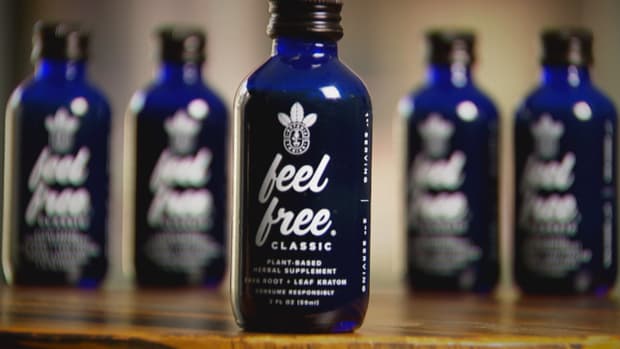
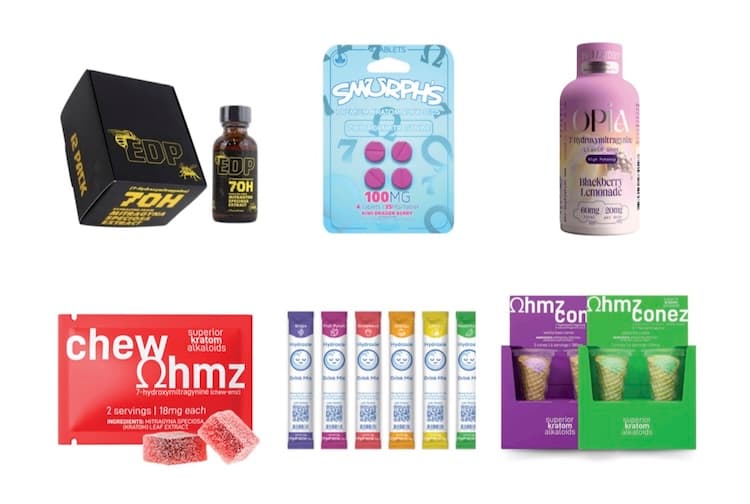
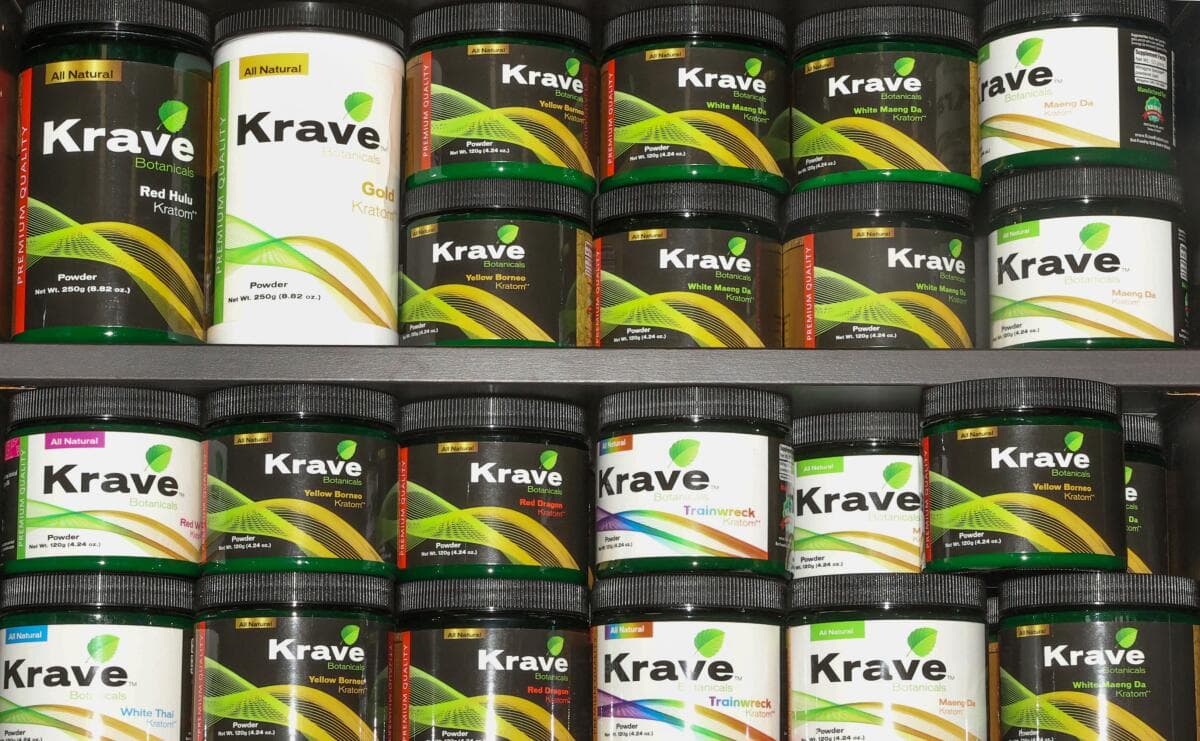
"Feel free". A plant-based "wellness" shot (kava root and leaf kratom) sold right at the register, marketed as a casual pick-me-up.
From a leaf to a synthetic opioid
Kratom starts as the leaf of Mitragyna speciosa, a tree in the coffee family native to Southeast Asia, where the leaves have been chewed and brewed for generations. In the leaf, the main active alkaloid is mitragynine, a mild partial opioid.
The trouble is what the market has done with it. Products are increasingly built around 7-OH, the leaf's far more potent metabolite, concentrated or synthesized well beyond anything the plant produces. The chemistry below is the difference between an herbal tea and a high-dose opioid.
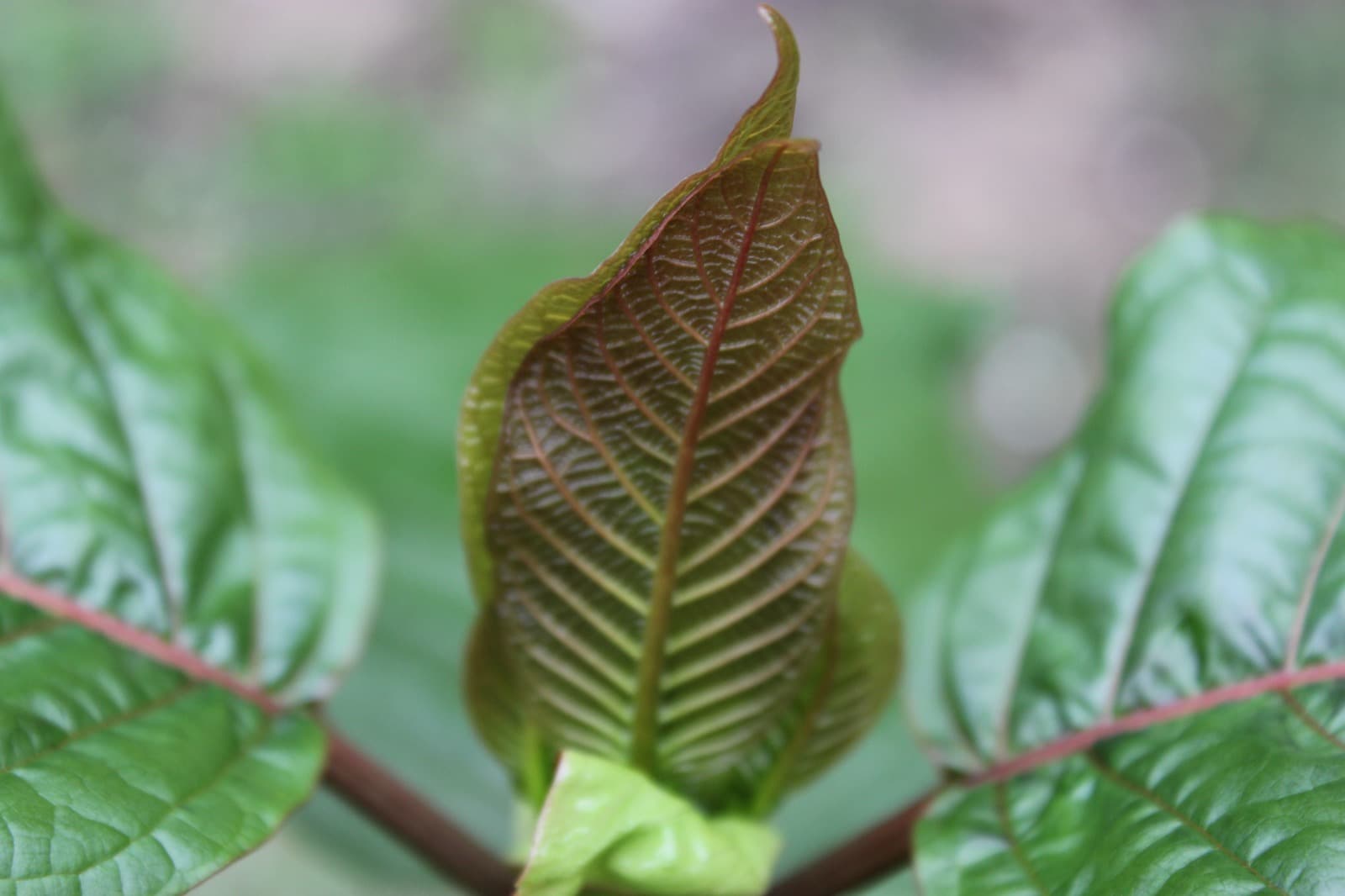
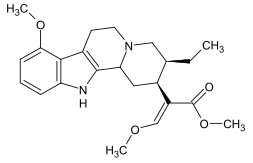
Mitragynine
The kratom leaf's main alkaloid, a low-efficacy partial agonist at the mu-opioid receptor. In the body it converts into 7-OH.
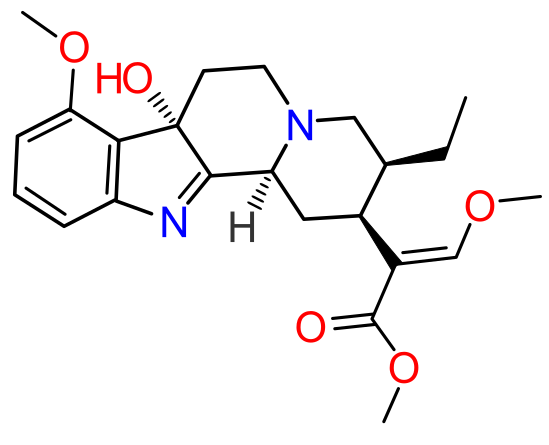
7-Hydroxymitragynine (7-OH)
A trace metabolite the FDA calls "an opioid that can be more potent than morphine", now concentrated or synthesized into standalone tablets, gummies, and shots.
Your pre-ibogaine detox protocol for kratom & 7-OH
Minimizing Withdrawals

What's included in your program
- Natural ibogaine treatment led by spiritual guides and iboga facilitators, with a licensed medical team on hand
- Preparation and integration support with trained psychotherapists
- A supervised pre-ibogaine detox tailored to your kratom or 7-OH use
- Pre-treatment Ayurvedic cleansing protocol (sweat, colonics, nutrition, exercise)
- Post-treatment integration support for months, not days, during the Window of Wonder (WoW)
- Accommodations at our luxury rainforest center for the full program
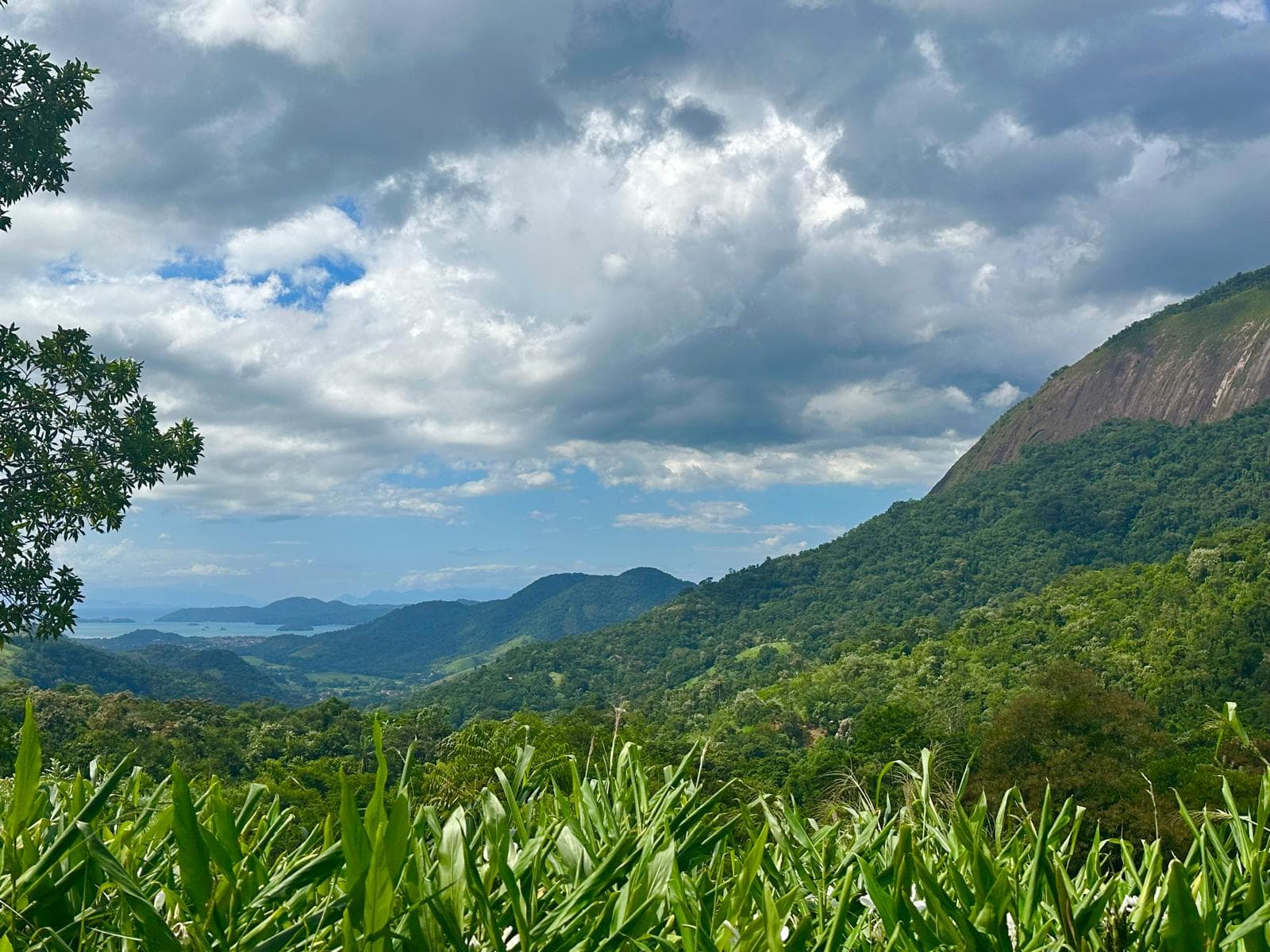
- Nature immersion: rainforest, ocean, and mountain
Suggested Programs
Kratom and 7-OH are shorter-acting than drugs like fentanyl, so the detox runway is shorter too. Most people who come to us for kratom or 7-OH fit one of these programs, depending on how heavy and how long the use has been.
28 days
28-Day Program
Our most-chosen option, room to clear concentrated 7-OH, settle the receptor, and build a real foundation for staying off it.
Learn more →6, 8 or 12 weeks
Advanced Program
For heavy, long-term 7-OH or extract use, or when other dependencies are in the picture and more time is warranted. Available in 6, 8, or 12-week formats.
Learn more →
Ibogaine vs. conventional treatment
For years kratom sat in a gray zone: sold openly as a supplement, never approved as a drug, and left largely unregulated. That changed once companies began stripping out 7-OH and selling it on its own.
Because 7-OH occurs only in trace amounts in the leaf, these products are chemically concentrated or semi-synthetic. Newer derivatives go further still: MGM-15 (dihydro-7-hydroxymitragynine) is a lab-made analog of 7-OH, sold in tablets and shots that often contain no natural kratom at all.⁸
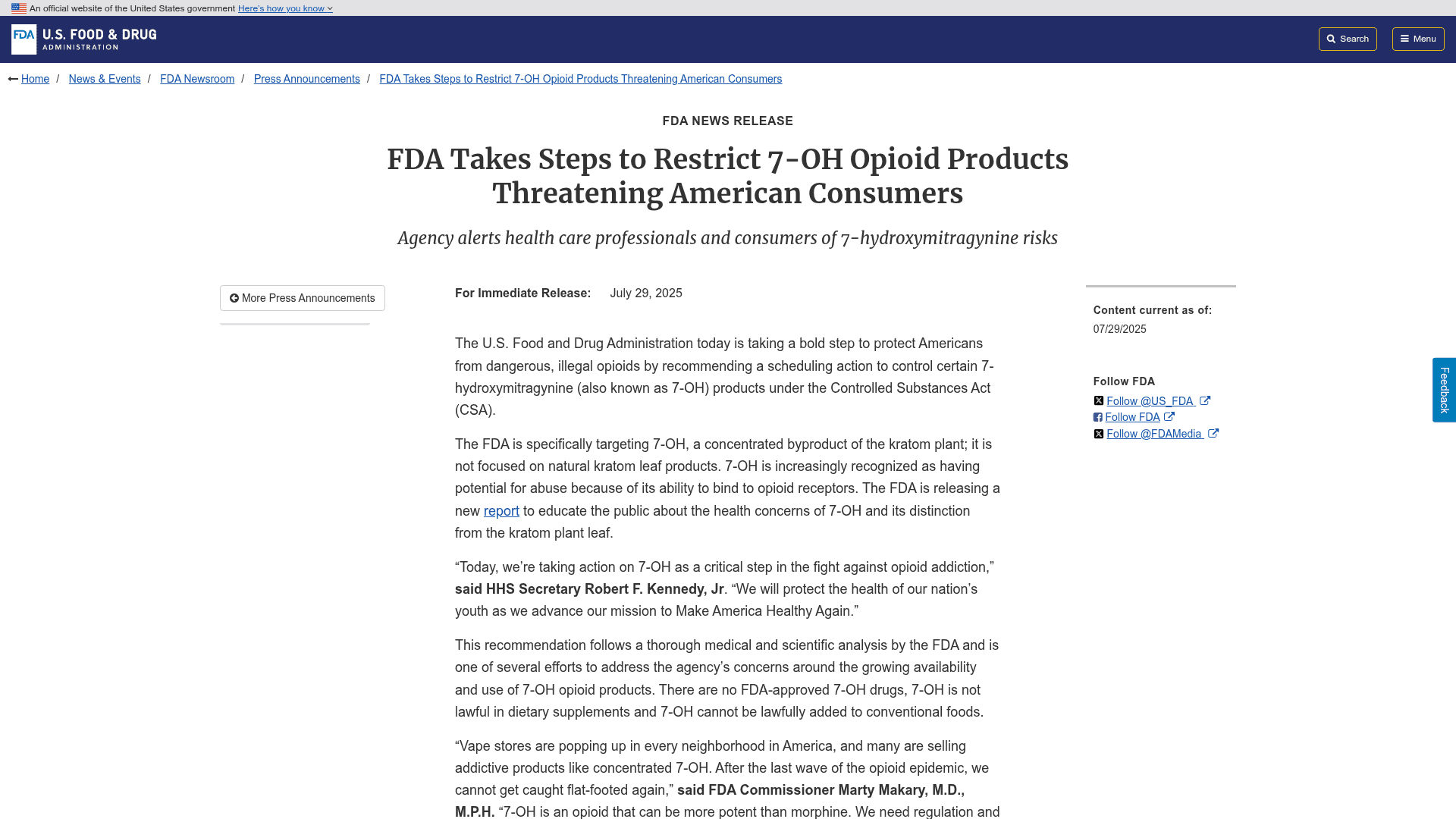
Regulators have moved to catch up. In July 2025 the FDA recommended that concentrated 7-OH be scheduled as a controlled substance, calling it "an opioid that can be more potent than morphine."⁵
The pressure escalated in 2026. In December 2025 federal agents seized roughly $1 million of illegal 7-OH products, and on July 1, 2026 the DEA filed notice to temporarily place 7-OH and its synthetic derivatives, including MGM-15, into Schedule I.⁶
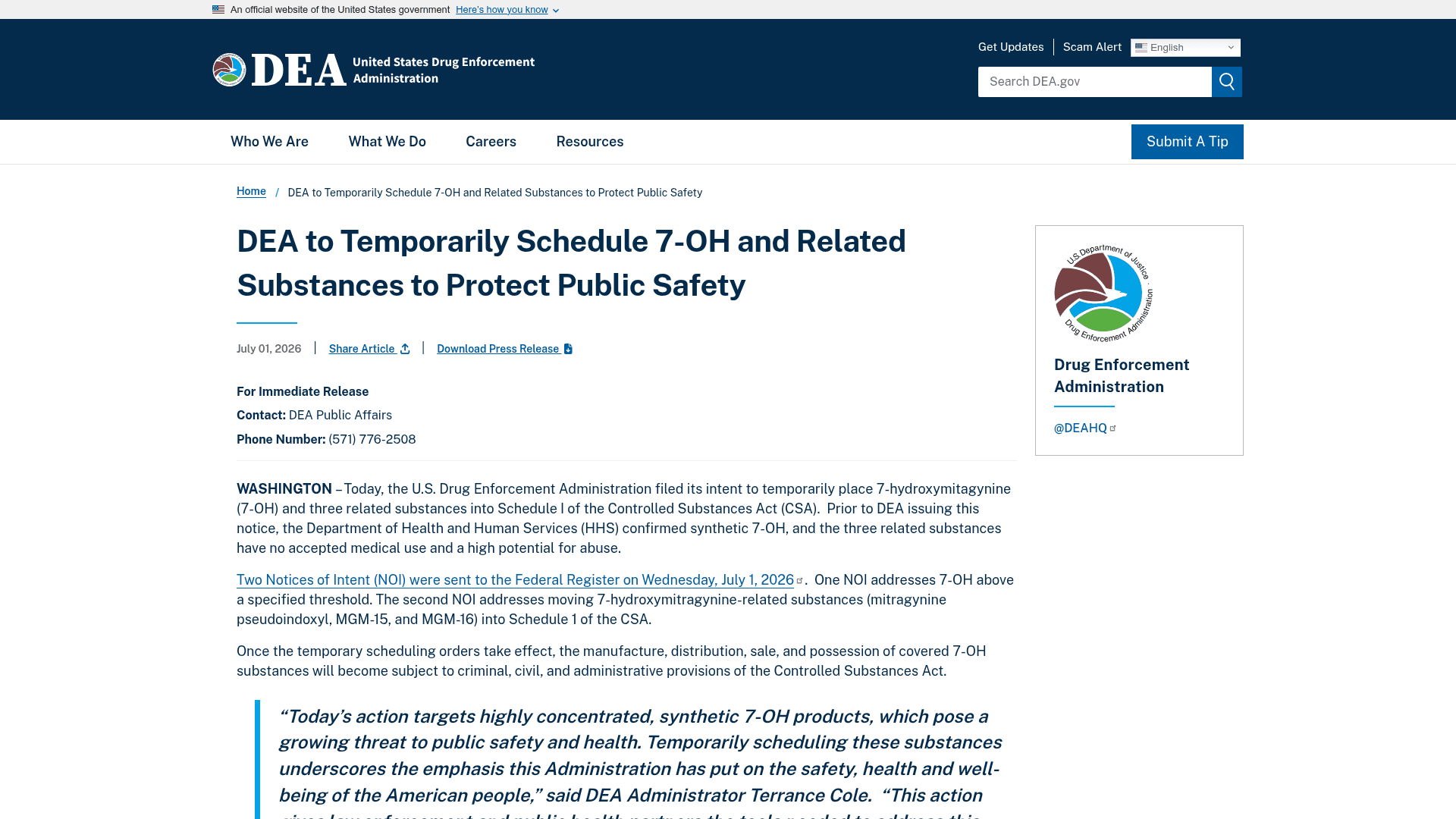
As of mid-2026 these bans are not yet in effect. A temporary scheduling order can't take hold before August 2026, and it targets the concentrated and synthetic products, not the natural leaf. Natural leaf kratom remains federally unscheduled, though about seven states have restricted or banned it outright.
Federal officials now compare the abuse potential of concentrated 7-OH to heroin, morphine, and fentanyl.
How ibogaine addresses this substance
Ibogaine works across four neurological and psychological dimensions, each specific to how this substance affects the brain.
Receptor Reset
Kratom and 7-OH hold onto the mu-opioid receptor the same way other opioids do. Ibogaine acts directly on those receptors, returning the system toward its pre-addiction baseline instead of feeding it a substitute.
Withdrawal Relief
Kratom withdrawal is opioid withdrawal, aches, sweats, insomnia, and relentless craving. Ibogaine interrupts that cascade, and most students tell us the physical symptoms ease within hours of ibogaine treatment.
Craving Interruption
The pull toward another dose is what usually breaks a quit attempt. Ibogaine quiets that loop at the neurological level, opening a window where the craving simply isn't running your day.
Neural Repair
Ibogaine stimulates BDNF and other growth factors that help the brain rebuild after dependency. We pair ibogaine treatment with nutrition, rest, and integration support to make that repair last.
Ibogaine aftercare is the best way to ensure long-term success

Citations (7)
[1] Davis AK, Barsuglia JP, Windham-Herman AM, Lynch M, Polanco M (2017). Subjective effectiveness of ibogaine treatment for problematic opioid consumption: Short- and long-term outcomes and current psychological functioning. Journal of Psychedelic Studies, 1(2), 65–73. Read the source →
Survey of 88 people who received ibogaine for opioid use disorder. 80% indicated ibogaine eliminated or drastically reduced withdrawal symptoms; 30% reported never using opioids again; 54% of those abstainers had been abstinent for at least one year.
[4] U.S. Food and Drug Administration (FDA) (2024). FDA and Kratom. U.S. Food and Drug Administration, Public Health Focus. Read the source →
States that an estimated 1.7 million Americans aged 12 and older used kratom in 2021, per the Substance Abuse and Mental Health Services Administration (SAMHSA) National Survey on Drug Use and Health.
[5] U.S. Food and Drug Administration (FDA) (2025). FDA Takes Steps to Restrict 7-OH Opioid Products Threatening American Consumers. U.S. Food and Drug Administration, Press Announcements (July 29, 2025). Read the source →
FDA recommended a scheduling action for concentrated 7-hydroxymitragynine (7-OH) products and described 7-OH as "an opioid that can be more potent than morphine," while distinguishing concentrated 7-OH from natural leaf kratom.
[6] U.S. Department of Health and Human Services (HHS) and U.S. Food and Drug Administration (FDA) (2026). HHS, FDA Commend DEA Action Against Dangerous Enhanced 7-OH Products. U.S. Department of Health and Human Services, Press Room (July 1, 2026). Read the source →
On July 1, 2026 the DEA issued two Notices of Intent to temporarily place 7-OH (above a threshold) and its synthetic derivatives — including dihydro-7-hydroxymitragynine (MGM-15) — into Schedule I. Federal officials compared their abuse potential to heroin, morphine, and fentanyl, and noted a roughly $1 million seizure of illegal 7-OH products in December 2025.
[7] World Health Organization, Expert Committee on Drug Dependence (ECDD) (2021). Kratom (Mitragyna speciosa), mitragynine and 7-hydroxymitragynine: Critical Review Report. World Health Organization, 44th ECDD. Read the source →
Concludes that mitragynine and 7-hydroxymitragynine act as partial agonists at the mu-opioid receptor, with 7-OH binding the receptor several times more strongly than mitragynine.
[8] Alsbrook S, et al. (2025). From kratom to 7-hydroxymitragynine: evolution of a natural remedy into a public-health threat. Pharmaceutical Biology, 63(1), 896–911. Read the source →
Peer-reviewed review of 7-OH pharmacology (far higher mu-opioid receptor affinity than mitragynine) and the 2024–2025 emergence of concentrated 7-OH and semi-synthetic derivatives such as MGM-15 in consumer products.
[9] Mash DC, Duque L, Page B, Allen-Ferdinand K (2018). Ibogaine Detoxification Transitions Opioid and Cocaine Abusers Between Dependence and Abstinence: Clinical Observations and Treatment Outcomes. Frontiers in Pharmacology, 9, 529. Read the source →
Open-label study reporting that ibogaine therapy in a safe dose range diminished opioid withdrawal symptoms and reduced drug cravings, transitioning opioid- and cocaine-dependent patients toward abstinence.