

Neuroplasticity
What does ibogaine do to the brain?
The short version is that ibogaine increases neuroplasticity, and for a while afterward it makes an adult brain behave like a much younger one. The protein lattice that holds settled circuits in place loosens, connections remodel, and long-fixed patterns stop being fixed. Most of what we know about ibogaine and neuroplasticity was measured in mice. The part measured in people is smaller and newer, and worth reading carefully.
What ibogaine does for neuroplasticity, in three parts
Ask what ibogaine does to the brain and most answers stop at receptors. That is the least interesting part. The three things below are what the neuroplasticity research is actually about, and only the first is about receptors at all.
It acts on many systems at once
Not one receptor. Ibogaine touches serotonin transport, NMDA glutamate receptors, nicotinic and opioid receptors, and neurotrophic signalling, all in the same dose. No single-target drug has reproduced the effect.
It opens a window that outlasts the drug
The compound clears in a day or two. The plasticity does not. In animals the brain stays unusually malleable for weeks afterward, which is the part that matters clinically.
What gets built in that window is up to you
A malleable brain is not automatically a healthier one. It takes the shape of whatever happens next, which is why the weeks after treatment carry as much weight as the treatment itself.
For the receptor-by-receptor version, and where iboga comes from, start with how ibogaine works. This page stays on neuroplasticity: what loosens, what rebuilds, and what has actually been measured.
.png&w=3840&q=75&dpl=dpl_2Hadai2PQUYdxntTHR92hX9oKNZD)
The drug leaves. The effect does not.
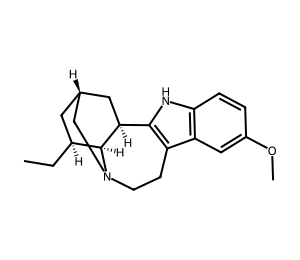
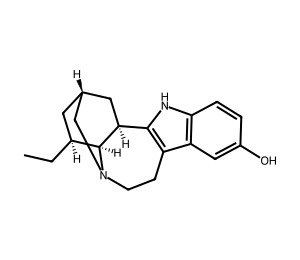
Your liver converts ibogaine into noribogaine, which lingers far longer than the parent compound. That gap, between a molecule that clears and an effect that keeps going for weeks, is the thing this whole page is trying to explain.
Your brain keeps circuits still on purpose. This takes the brakes off.
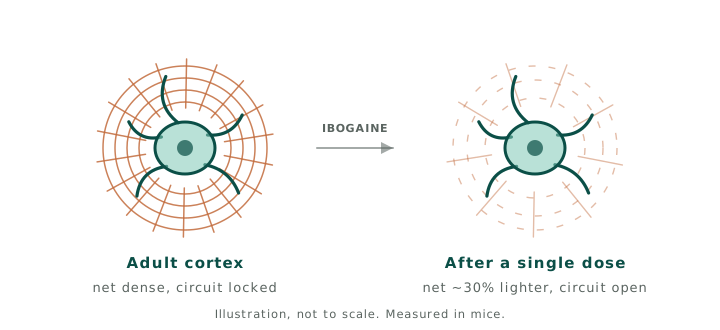
Around many neurons in an adult brain there is a lattice of proteins called a perineuronal net. It forms once a developing circuit has finished learning something, and its job is to hold the result in place. It is a large part of why a child picks up an accent and an adult mostly does not.
In mice given a single dose, that lattice thinned. Net staining fell by roughly 30%, fewer of the fast-spiking interneurons underneath stayed wrapped in it, and the inhibitory contacts on them dropped as well. The researchers then covered one eye for four days, and the visual cortex responded the way a juvenile cortex responds and an adult one does not.⁵¹
A plastic brain is not a better brain. It is a brain that takes the shape of what happens next.
That cuts both ways, and it is the entire argument for what the weeks afterward should look like. An open window in a chaotic life is not obviously a gift.
Something has to build in the space that opens
A single dose raises two of the growth factors the brain uses to build and maintain connections: BDNF, in the nucleus accumbens, substantia nigra and prefrontal cortex, and GDNF, in the ventral tegmental area.¹⁷ Put ibogaine directly into the VTA of a rat and its drinking falls on its own, which points toward repair of a circuit rather than a chemical lid held down on top of one.¹⁵
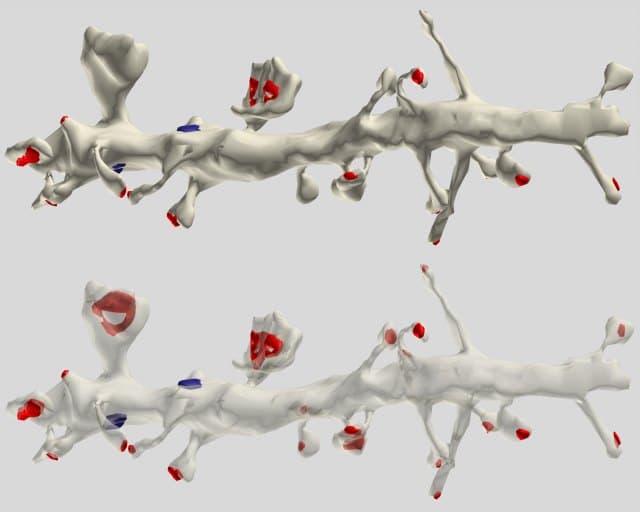
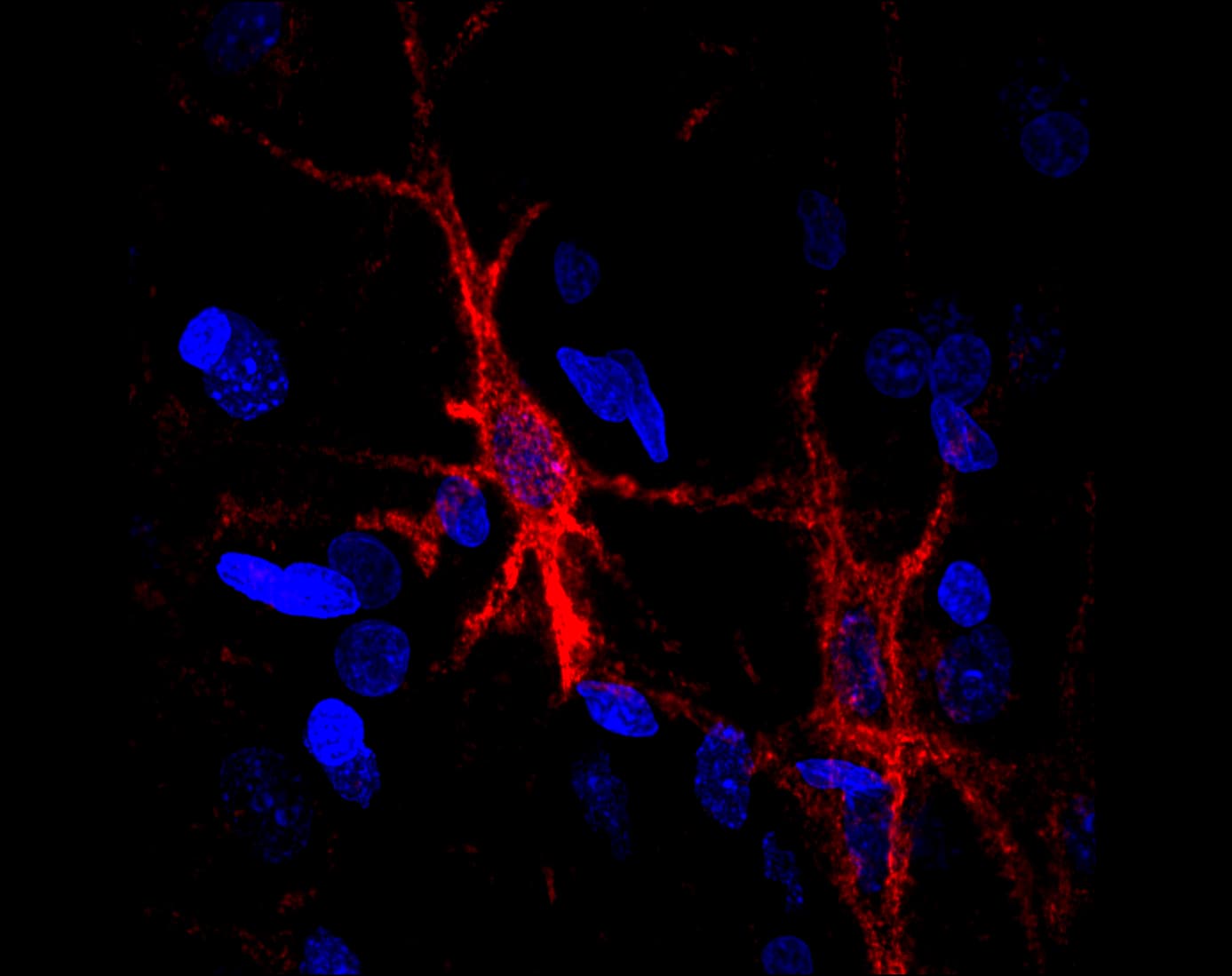
Those knobs on the branch are dendritic spines, and the red patches are synapses. This is what a well-connected neuron looks like up close. Spines are not fixed furniture. They appear, strengthen and disappear depending on what you do.
Across this class of compounds, and noribogaine appears in that work alongside the classic psychedelics, cortical neurons grow more branches, more spines and more synapses, through TrkB, mTOR and AMPA receptor signalling.⁵³ All of it is preclinical, which is to say cells and rodents, not people.
The strangest finding, and the one people recognise
Mice were imaged while they moved around, and the researchers read the animal position straight out of a region called the retrosplenial cortex. After ibogaine that reading fell apart. Error in decoding where the animal actually was rose roughly threefold, and the neurons started behaving more independently of one another. What did not change was the response to real sensory cues. The senses kept working. The map built on top of them stopped holding still.⁵²
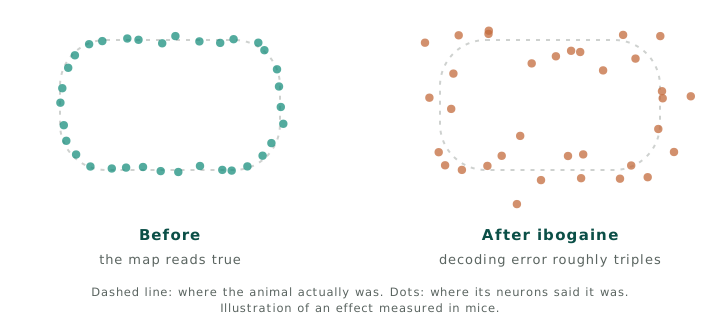


Everything above is rodent work. This part is not.
The human evidence comes almost entirely from one group: 30 US Special Operations veterans with traumatic brain injury, who travelled abroad for treatment and were scanned and tested by Stanford on both sides of the trip.⁴²
11 of 13
cortical regions measurably thicker⁴³
About a week after treatment, and still there at one month rather than settling back.
1.60 years
drop in predicted brain age⁴³
Feed a structural scan to a model and it estimates how old that brain looks. The estimate fell.
slower rhythms
theta and alpha up, beta and gamma down⁴⁴
The men whose rhythms shifted most were the men whose cognitive inhibition improved most.
A separate EEG analysis of the same cohort found a shift in high-beta brain networks that tracked how much each man improved, and the same shift turned up again in an independent group of 11 people treated for opioid use disorder.⁴⁵ That second appearance is worth more than it sounds. A result that only ever shows up in one group of people is, as far as anyone can tell, a result about that group. This one held in different people, with a different problem, recorded separately.
There’s still much to be proven
Almost everything on this page was measured in mice, by injection, at doses that do not translate to a person swallowing a capsule. The perineuronal net study is a preprint and has not completed peer review. Animal plasticity findings have a long history of not surviving the trip into humans.
The human data is one cohort of 30 men. All veterans, all male, all screened into a study, with no control group and no placebo, and everyone involved knew what they were taking. A change that holds at one month is not the same as a repair that lasts.
And plasticity is not healing. It is malleability. The research says the brain becomes more changeable for a while. It does not say the changes are good ones, and nothing in it tells you what will happen to any individual person.
None of that is a reason to look away. It is the reason ibogaine is finally being put through the process properly.
The first trial of ibogaine built to modern regulatory standards opened in the United Kingdom in 2021, cleared by the MHRA, and its sponsor is now running a combined Phase 2 and Phase 3 program. Two Phase 2 studies finished in 2024, one in São Paulo in people with alcohol use disorder and one in Reus, Spain, in people maintained on methadone. Both are awaiting published results. A neuroimaging study at the University of California, Irvine is scanning people with opioid use disorder to see what moves in reward circuitry.
What pushed it that far was not a laboratory finding. It was people, in numbers, over decades. Every piece of human efficacy evidence we have so far comes from open-label studies, retrospective reviews and case reports, which is the weakest tier of evidence medicine has.⁵⁴ But there is a great deal of it, accumulated across tens of thousands of treatments worldwide, and it keeps pointing the same direction. Craving drops. Then the less measurable things move with it: sleep, mood, anxiety, the ability to think clearly.⁴⁶ What we see afterward, and what the research has no instrument for yet, is people treating themselves and the people around them differently. That is the observation these trials were built to test.
None of it arrives on its own. Ibogaine is not an approved treatment for anything in most of the world, and it carries a real cardiac risk that has killed people who were not screened properly. The changes people describe belong to the ones who were screened honestly, treated under monitoring, and who did the work in the weeks that followed. We would rather you read that here than find it out later.
Increased neuroplasticity is only worth having if you use it
If the research is pointing anywhere useful, it is here. Treatment is a single day. The brain does its rebuilding across the weeks either side of it, and what it needs in that stretch is not exotic: sleep deep enough to clear the day, real food, movement, sunlight, and long stretches without a screen pulling at your attention.
This is the part people skip. Raised neuroplasticity is not a result, it is a condition. A brain that is easier to change will change around whatever you put in front of it, which is why what fills those weeks matters as much as the treatment that opened them.
Those are among the best evidenced things you can do for a brain, and almost nobody sustains them inside an ordinary life. So the program is built to make them unavoidable. You are on a rainforest campus with the ocean and the mountains around you, eating food grown nearby, moving every day, and away from the noise long enough that your nervous system stops bracing.

Questions people actually ask
Citations (12)
[15] He DY, McGough NN, Ravindranathan A, Jeanblanc J, Logrip ML, Phamluong K, Janak PH, Ron D (2005). Glial Cell Line-Derived Neurotrophic Factor Mediates the Desirable Actions of the Anti-Addiction Drug Ibogaine against Alcohol Consumption. The Journal of Neuroscience, 25(3), 619–628. Read the source →
Rodent study identifying GDNF signalling in the ventral tegmental area as the mechanism through which ibogaine reduces alcohol intake, including in a relapse model. Ibogaine injected directly into the VTA produced dose-dependent reductions in ethanol self-administration.
[17] Marton S, González B, Rodríguez-Bottero S, et al. (2019). Ibogaine Administration Modifies GDNF and BDNF Expression in Brain Regions Involved in Mesocorticolimbic and Nigral Dopaminergic Circuits. Frontiers in Pharmacology, 10, 193. Read the source →
Rodent study showing that a single dose of ibogaine raises BDNF expression in the nucleus accumbens, substantia nigra, and prefrontal cortex, and selectively raises GDNF in the ventral tegmental area at the dose range effective in self-administration models.
[42] Cherian K, Keynan J, Anker L, Faerman A, Brown R, Shamma A, Keynan O, Coetzee J, Batail JM, Phillips A, Bassano N, Sahlem G, Inzunza J, Millar T, Dickinson J, Rolle C, Keller J, Adamson M, Kratter I, Williams N (2024). Magnesium-ibogaine therapy in veterans with traumatic brain injuries. Nature Medicine, 30, 373–381. Read the source →
The MISTIC trial. 30 male US Special Operations Forces veterans with predominantly mild traumatic brain injury received intravenous magnesium plus oral ibogaine (mean 12.1 mg/kg); 23 met criteria for PTSD at baseline. One month after treatment the group had moved from mild-to-moderate disability to no disability on the WHODAS-2.0 (30.2 to 5.1, d = 2.20), the study primary outcome. PTSD symptoms fell 88% on average, with a 100% response rate and 86% remission (d = 2.54); depression fell 87% (83% remission) and anxiety 81% (83% remission). Suicidal ideation fell from 47% at baseline to 7% at one month. Participants also gained in processing speed, executive function, verbal fluency and verbal learning, with no cognitive decline on any measure, and there were no serious or unexpected treatment-emergent adverse events. Open-label and uncontrolled, in a highly selected cohort, with magnesium co-administered, so the effect cannot be attributed to ibogaine alone.
[43] Adamson M (2025). Changes in Brain Structure and Age in Veterans With TBI After Treatment With Magnesium-Ibogaine. Archives of Physical Medicine and Rehabilitation, 106(4), e162–e163. Read the source →
The first in-human structural MRI evidence of brain change after ibogaine. In the same 30 MISTIC veterans, cortical thickness increased significantly in 11 of 13 regions of interest at roughly 7 days post-treatment and was sustained at one month, and predicted brain age fell by 1.60 years at one month (d = 1.035, p = 0.0082). The authors describe the findings as consistent with a proposed neurotrophic mechanism, not as confirmation of one.
[44] Lissemore JI, Chaiken A, Cherian KN, Buchanan D, Espil F, Keynan JN, Sridhar M, Rolle CE, Saggar M, Keller CJ, Williams NR (2025). Magnesium-ibogaine therapy effects on cortical oscillations and neural complexity in veterans with traumatic brain injury. Nature Mental Health, 3(8), 918–931. Read the source →
The first reported in-human evidence that ibogaine alters cortical oscillations in a clinically meaningful way. After treatment, slower theta-alpha rhythms gained power while faster beta-gamma activity lost it, raising the theta/beta ratio in a way that correlated with improved cognitive inhibition. Peak alpha frequency and neural complexity were lower, and the changes persisted at one-month follow-up.
[45] Shinozuka K, Rosso M, Chaiken A, Lissemore JI, Jones R, Descalco N, Subramani V, Belgers M, Cherian KN, Arns M, Momi D, Airan RD, Bonetti L, Schellekens A, Adamson MM, Keller CJ, Rolle C (2026). Ibogaine is associated with reorganization of high-beta brain networks in veterans with post-traumatic stress disorder. Neuroscience. Read the source →
EEG network analysis of the MISTIC cohort found a posterior shift in high-beta (24–25 Hz) network activation present at 3–4 days and one month after treatment, correlating with PTSD symptom improvement on the CAPS-5 (r = -0.66 immediately post, r = -0.53 at one month). Modelling attributed the shift to a roughly 15% reduction in cortico-cortical gain. Notably, the finding replicated in an independent EEG dataset of 11 opioid use disorder patients treated with ibogaine alone, without magnesium.
[46] Davis AK, Xin Y, Sepeda N, Averill LA (2023). Open-label study of consecutive ibogaine and 5-MeO-DMT assisted-therapy for trauma-exposed male Special Operations Forces Veterans: Prospective data from a clinical program in Mexico. The American Journal of Drug and Alcohol Abuse, 49(5), 587–596. Read the source →
A prospective open-label cohort of 86 trauma-exposed Special Operations Forces veterans reported large improvements in PTSD, depression, anxiety, insomnia, post-concussive symptoms and cognitive functioning, with preliminary signals of durability to six months. Because ibogaine was given alongside 5-MeO-DMT and psychotherapeutic support, the therapeutic effect cannot be attributed to ibogaine alone.
[51] Acuña A, Billeri F, Totaro V, Carrera I, Mesa JM, Pizzorusso T, Rossi FM (2025). Ibogaine induces juvenile-like plasticity and modulates functional and structural regulators of plasticity in the adult mouse visual cortex. Preprint, in review (Research Square). Read the source →
Mouse study reporting that a single dose of ibogaine (40 mg/kg) restored a juvenile-like plasticity response in the adult visual cortex: four days of covering one eye then shifted visual acuity and reduced dendritic spine density, which normally only happens during the developmental critical period. Ibogaine also reduced perineuronal net staining intensity and density by roughly 30%, lowered the share of parvalbumin interneurons wrapped in those nets, and reduced inhibitory vGAT puncta, all consistent with the cortex being disinhibited. Vehicle-treated controls showed none of it. A preprint that has not completed peer review, in mice, at a dose that does not translate directly to humans.
[52] Ivan VE, Tomàs-Cuesta DP, Esteves IM, Curic D, Mohajerani M, McNaughton BL, Davidsen J, Gruber AJ (2024). The Nonclassic Psychedelic Ibogaine Disrupts Cognitive Maps. Biological Psychiatry Global Open Science, 4(1), 275–283. Read the source →
Two-photon calcium imaging in mice showed that ibogaine destabilised the brain internal map of space. Position-related firing in retrosplenial cortex neurons lost reliability, error in decoding the animal location from population activity rose roughly threefold, and functional connectivity reorganised toward greater independence between neurons, while responses to actual sensory cues were preserved. Offered by the authors as a candidate mechanism for how ibogaine loosens rigid learned patterns. Animal study.
[53] Ly C, Greb AC, Cameron LP, Wong JM, Barragan EV, Wilson PC, Burbach KF, et al. (2018). Psychedelics Promote Structural and Functional Neural Plasticity. Cell Reports, 23(11), 3170–3182. Read the source →
Cell and rodent study showing that psychedelics, including the iboga alkaloid noribogaine, increase dendritic branching, dendritic spine density and synapse number in cortical neurons, through TrkB, mTOR and AMPA receptor signalling. Establishes that the structural remodelling is a shared property of the class rather than something specific to one compound. Preclinical.
[54] Esperança MP, Gomes NG, Campos MG (2026). Ibogaine: Therapeutic Potential, Cardiac Safety, and Translational Perspectives in the Treatment of Substance Use Disorders. A Scoping Review. Molecules, 31(3), 545. Read the source →
Scoping review establishing the current tier of human evidence for ibogaine: no randomized, placebo-controlled trial has yet evaluated its efficacy in substance use disorders, and every human efficacy finding to date comes from open-label observational studies, retrospective analyses and case reports. Also covers the cardiac safety profile and the translational work now moving ibogaine into regulated clinical development.
[55] Nardou R, Sawyer E, Song YJ, Wilkinson M, Padovan-Hernandez Y, de Deus JL, Wright N, Lama C, Faltin S, Goff LA, Stein-O'Brien GL, Dölen G (2023). Psychedelics reopen the social reward learning critical period. Nature, 618(7966), 790–798. Read the source →
Mouse study from Gül Dölen's lab testing five psychedelics (ketamine, psilocybin, MDMA, LSD and ibogaine) and finding that each reopens a critical period for social reward learning that adult animals have normally lost. The length of the reopened window tracked the duration of the acute subjective effects reported in humans: roughly 48 hours for ketamine, about two weeks for psilocybin and MDMA, about three weeks for LSD, and about four weeks for ibogaine, the longest of the five. Preclinical. The open state was measured behaviourally in mice, not by any direct readout of plasticity in a person.