
Ibogaine treatment for fentanyl may be the best approach out there
Fentanyl rewires the opioid receptor until your body needs it just to feel normal. Every missed dose sets off withdrawal, and willpower has nothing to do with it. Ibogaine treatment for fentanyl works on the mu-opioid receptors directly, and most students tell us their physical withdrawal dropped sharply, or disappeared, within hours.
Medical care connected to the program is provided by licensed medical professionals under their own licenses. See our medical disclaimer.
Over 73,000 Americans died from synthetic opioid overdoses in 2022, most of them from fentanyl²
If you're reading this, you've probably already tried to stop. Detox, suboxone, methadone, sheer willpower. Fentanyl outlasts all of it, and not because you're weak. The receptor won't let go.
Ibogaine doesn't manage withdrawal. It interrupts the receptor mechanism that causes it in the first place. That's a different kind of treatment than anything else you've been offered.
“Fentanyl does not leave room for a slow taper. People arrive frightened, and they are right to be.”
Charles D. Johnston, Co-Founder, Nekawa
How Nekawa treats fentanyl addiction
Fentanyl needs a different approach than short-acting opioids. The receptor damage runs deeper, the withdrawal lasts longer, and the standard answer is usually methadone or suboxone, which trades one dependency for another.
Ibogaine for fentanyl resets the mu-opioid receptor toward its pre-addiction state, so it removes the physical basis of the dependency instead of just managing it. For most students the physical withdrawal eases within hours, not weeks.¹
The preparation is where this is won or lost. A 21 to 30 day protocol clears stored fentanyl out of fat tissue before the ibogaine treatment, and that's what makes the reset both safe and complete.
One more number, because you deserve the honest version: the largest ibogaine safety analysis to date, a 2026 review of 19,071 patients across 11 clinics (still a preprint, not yet peer reviewed), found six deaths within 72 hours of treatment. All six were opioid detox patients. Three involved fentanyl.⁸⁵ The risk is cardiac, it concentrates in exactly this treatment, and it is why the cardiac screening, the long preparation, and ECG monitoring during the experience are not negotiable. How ibogaine works →
Why fentanyl is so hard to break
Fentanyl is 50 to 100 times stronger than morphine. The mu-opioid receptor doesn't just grow dependent on it. It reorganizes around the drug and dials down your own endorphin production, until the body can't feel normal without fentanyl in it. That's a physical change in the brain.
Fentanyl also hides in fat tissue. It stores there and leaks back into the bloodstream for weeks after the last dose, which is why going cold turkey rarely holds and why substitution drugs tend to create a new dependency instead of ending the old one. Your body keeps releasing stored fentanyl, so a clean detox takes a structured, multi-week run-up. People on patches or high-dose IV fentanyl face the longest, hardest opioid detox there is.
Ibogaine works on the same mu-opioid and NMDA receptors fentanyl took over, guiding them back toward where they worked before the dependency took hold. Is ibogaine safe? →
Your pre-ibogaine treatment for fentanyl protocol
What's included in your program
- Natural ibogaine treatment led by spiritual guides and iboga facilitators, with a licensed medical team on hand
- Preparation and integration support with trained psychotherapists
- Pre-treatment Ayurvedic cleansing protocol (sweat, colonics, nutrition, exercise)
- Post-treatment integration support for months, not days, during the Window of Wonder (WoW)
- Accommodations at our luxury rainforest center for the full program
- BDNF stimulation protocols for faster neural repair
- Nature immersion: rainforest, ocean, and mountain
Suggested Programs
Coming off fentanyl isn't a weekend job. The stored drug has to clear and the receptor has to settle, and that takes weeks, so these are our longer programs. Most people who come to us for fentanyl land in the 8-week range.

Ibogaine vs. conventional treatment
| Ibogaine at Nekawa | Conventional Treatment | |
|---|---|---|
| Mechanism | Resets opioid receptors toward their pre-addiction state | Replaces fentanyl with a longer-acting substitute (methadone, suboxone) |
| Withdrawal | Most students see it drop sharply or disappear within hours | Withdrawal from MAT can be more severe and longer than the original opioid |
| Cravings | Craving loop interrupted at the neurological level | Cravings managed daily; dependency on the substitute continues |
| Duration | One program: 21 to 30 day prep, ibogaine treatment, then integration | Ongoing. Average MAT duration is 3+ years, and many stay on it indefinitely |
| Dependency goal | Zero dependency. Receptor reset with no replacement drug | Moves dependency from illicit fentanyl to prescribed methadone or suboxone |

Fentanyl changed the overdose crisis in a way no earlier drug did. It showed up in illicit markets around 2013 and now turns up in almost every street drug: pressed into fake Xanax, cut into cocaine, stamped to look like oxycodone. People who never went looking for an opioid end up dependent on one because of a single pill they thought was something else.
The conventional treatment system was built around heroin and prescription opioid users. It wasn't built for a drug this potent or this persistent. The result is tens of thousands of deaths a year among people who were trying to get help and couldn't stay clean long enough for the system to work.
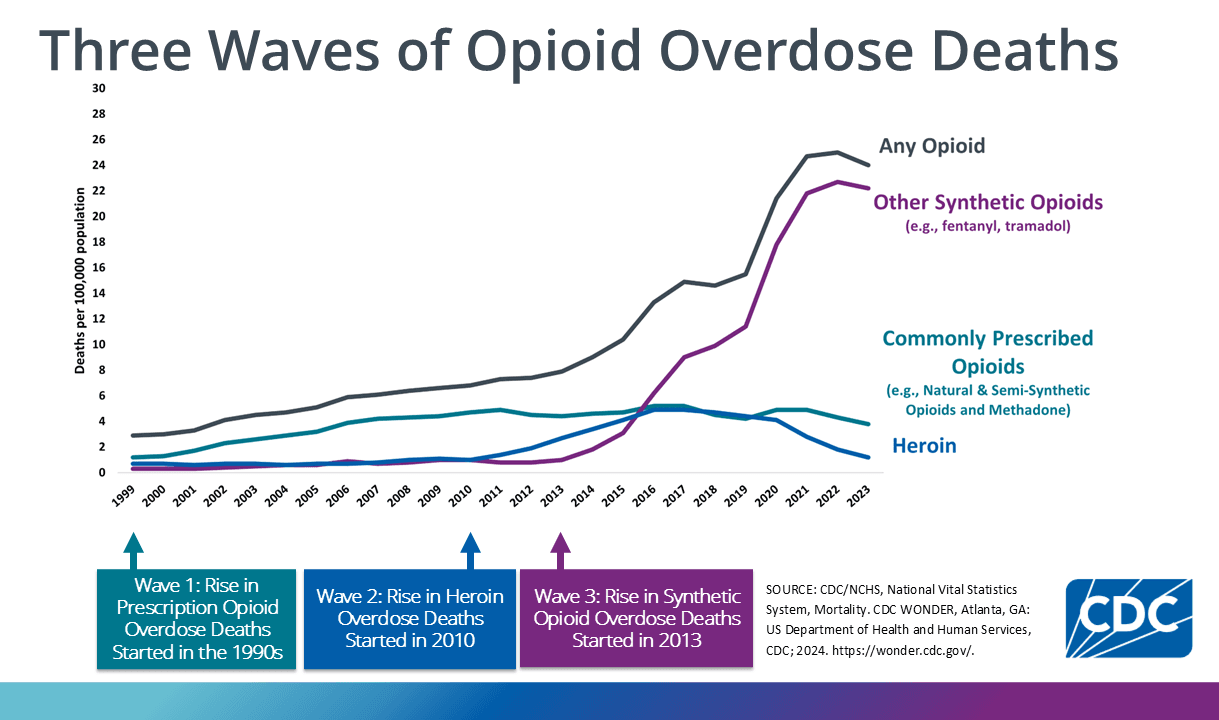
Synthetic opioids, overwhelmingly fentanyl, now account for roughly 70% of all drug overdose deaths in the United States.²
How ibogaine addresses this substance
Ibogaine works across four neurological and psychological dimensions, each specific to how this substance affects the brain.
Receptor Reset
Fentanyl's grip on the mu-opioid receptor is physical, written into the wiring. Ibogaine acts directly on those receptors, and on the NMDA receptors beside them, returning the system toward its pre-addiction baseline. It works on the biochemistry of dependency at the source instead of managing around it.
Withdrawal Relief
Fentanyl withdrawal is about as bad as opioid withdrawal gets, and the fat-tissue redistribution drags it out for weeks. Ibogaine interrupts that process rather than substituting another drug for it. Most students see their physical symptoms ease sharply in the first 4 to 8 hours, including the protracted (PAWS) symptoms that usually linger for months.
Craving Interruption
The psychological pull of fentanyl, the part that sends people back despite knowing exactly what it costs, runs along deeply worn neural loops. Ibogaine disrupts the default-mode-network patterns and memory associations behind those loops. What follows is a stretch of clarity most people say they haven't felt since before they started using.
Root-Cause Clarity
For a lot of people, the trauma came before the fentanyl. But the addiction takes a heavy toll of its own. Years on it wear the body down and leave deep emotional damage, and that becomes part of what has to heal. The ibogaine experience tends to surface both at once: the wound that was already there, and what fentanyl itself has done to compound it. Seeing it clearly doesn't fix the root cause on its own, but it shifts how you relate to it in a way ordinary detox never reaches.
Ibogaine aftercare is the best way to ensure long-term success

Citations (5)
[1] Davis AK, Barsuglia JP, Windham-Herman AM, Lynch M, Polanco M (2017). Subjective effectiveness of ibogaine treatment for problematic opioid consumption: Short- and long-term outcomes and current psychological functioning. Journal of Psychedelic Studies, 1(2), 65–73. Read the source →
Survey of 88 people who received ibogaine for opioid use disorder. 80% indicated ibogaine eliminated or drastically reduced withdrawal symptoms; 30% reported never using opioids again; 54% of those abstainers had been abstinent for at least one year.
[2] National Institute on Drug Abuse (NIDA), based on CDC WONDER data (2024). Drug Overdose Death Rates. National Institutes of Health, citing CDC, National Center for Health Statistics, Multiple Cause of Death data. Read the source →
About 73,838 U.S. overdose deaths in 2022 involved synthetic opioids other than methadone (primarily fentanyl) — roughly two-thirds of the approximately 107,900 total drug overdose deaths that year. Also documents the longer trends: heroin-involved deaths peaked at about 15,500 in 2016 and fell to roughly 4,000 by 2023 (about 80% of remaining heroin deaths also involve illicitly manufactured fentanyl), deaths involving prescription opioids rose from about 3,400 in 1999 to a peak near 17,000 in 2017 before declining, and methadone continues to contribute thousands of overdose deaths each year.
[3] Centers for Disease Control and Prevention (CDC) (2025). Understanding the Opioid Overdose Epidemic. U.S. Centers for Disease Control and Prevention, Overdose Prevention. Read the source →
Describes the U.S. opioid overdose epidemic in three waves: prescription opioids (rising since the 1990s), heroin (from 2010), and synthetic opioids such as illicitly manufactured fentanyl (from 2013). Source of the three-waves overdose-death chart.
[85] Arns M, Shinozuka K, Barsuglia J (2026). Indication-stratified mortality risk of ibogaine treatment under contemporary safety protocols: a multisite analysis of 19,071 patients and updated systematic review of fatalities. Research Square preprint (posted 17 June 2026; not yet peer reviewed). Read the source →
The largest ibogaine safety analysis to date: 19,071 patients treated under the 2016 safety guidelines at 11 international clinics. Six deaths occurred within 72 hours of dosing (0.03%), all among the 10,382 opioid use disorder patients; there were none among 8,689 non-SUD patients. An updated systematic review found 41 of 44 fatalities with a known indication involved substance use disorder, predominantly opioid detox. The authors describe the 0.03% as a lower bound rather than the true rate, since clinic participation was voluntary and deaths were not independently adjudicated. A preprint that has not completed peer review; one author holds equity in ibogaine companies and was firewalled from the data analysis.
[85] Daly N, Jacobs A (2026). Americans Encounter Risks at Psychedelic Clinics Abroad. The New York Times, 26 August 2026. Read the source →
Investigation into overseas psychedelic clinics. The Times counted at least 40 clinics and wellness centers in Mexico offering ibogaine, up from almost none a decade ago, and found no official tally anywhere of injuries or deaths. Patients described absent medical screening, prescription drugs given without regard to medical history, pressure to stop psychiatric medications abruptly, upselling during treatment, and sexual assault with little legal recourse. Also reports a JAMA survey of 49 retreats and clinics in which fewer than half employed a medical professional and roughly 10% employed a staff member with emergency medical training.