
Ibogaine treatment for methadone, a way off the maintenance track
Methadone was meant to be a bridge, but for a lot of people it becomes the destination: years on a daily dose, tied to a clinic, with the taper feeling harder than the drug it replaced. Ibogaine treatment for methadone works on the same opioid receptors, aiming to end the dependence rather than maintain it. Because methadone is long-acting, the preparation is careful and longer than for other opioids.
Medical care connected to the program is provided by licensed medical professionals under their own licenses. See our medical disclaimer.
Methadone is the longest-acting of the common opioids, which makes it the hardest to taper off and the hardest to clear before ibogaine treatment; clinicians require it fully out of your system first¹²
If you have been on methadone for years, you already know the bind. It holds the withdrawal off, but every attempt to lower the dose brings it back, and the clinic schedule runs your life. That is not a failure of effort. Methadone is built to be hard to leave.
Ibogaine does not add another maintenance drug. It works on the receptor that methadone has been occupying, with the goal of resetting it rather than refilling it every day.
“Methadone patients are often the most stuck people we talk to. They are not in crisis, they are just quietly trapped, and getting off it safely takes the most patient preparation we do.”
Charles D. Johnston, Co-Founder, Nekawa
How Nekawa treats methadone addiction
Methadone needs the most careful preparation of any opioid we work with. Its long duration of action means it has to be fully out of your system before the ibogaine treatment, and rushing that is neither safe nor effective.
Ibogaine for methadone resets the mu-opioid receptor toward its pre-addiction state, so the aim is to end the dependence rather than move it onto another maintenance drug. In supervised detox cohorts, ibogaine has been reported to reduce opioid withdrawal and craving as patients transition toward abstinence.⁹ That evidence is observational, and we hold it as such.
The clearing is where this is won or lost. Because methadone is long-acting, standard clinical practice is to move onto a short-acting opioid and let the methadone wash out before treatment, which is exactly how the run-up is structured.¹² How ibogaine works →
Why methadone is so hard to break
Methadone is older than most people realize. Chemists at the Hoechst laboratories in Germany synthesized it in the late 1930s while searching for a synthetic painkiller, and after the war the formula crossed the Atlantic, where it was sold for pain under the brand name Dolophine. Its role in addiction treatment came in the 1960s, when researchers Vincent Dole and Marie Nyswander showed that a single daily oral dose of the long-acting opioid could hold off heroin withdrawal, and the methadone clinic system grew from there.
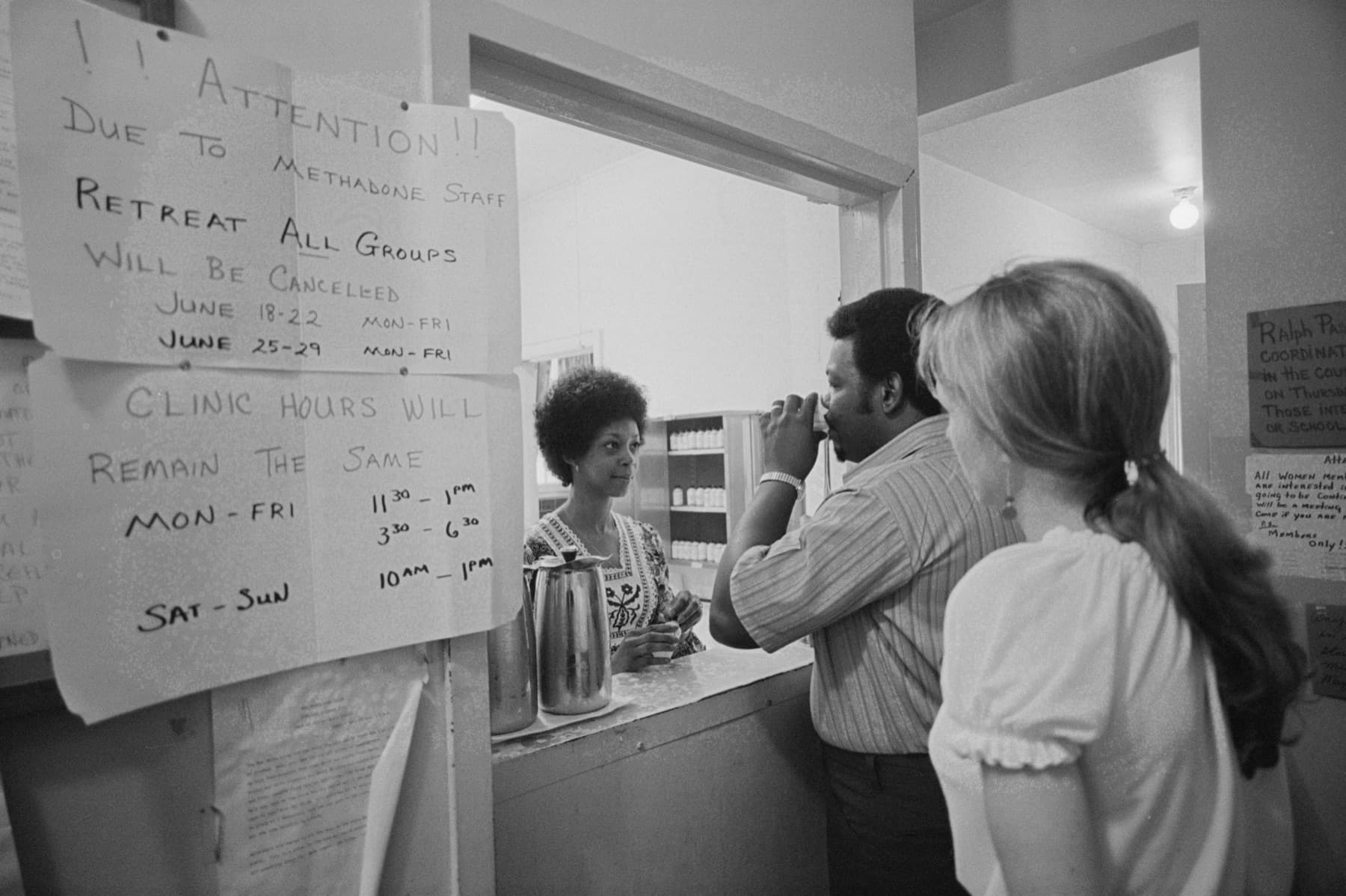
Methadone is a full opioid agonist with an unusually long duration of action. A single dose can stay active in the body far longer than heroin or oxycodone, which is exactly why it works well for daily maintenance and exactly why it is so hard to come off. The drug lingers, so a taper drags out and each reduction is felt for a long time.
On top of that, years of steady dosing keep the mu-opioid receptor continuously occupied, and your own endorphin system stays switched down the whole time. The dependence is stable but deep, and most people describe the methadone taper as harder and longer than the withdrawal from the opioid that first brought them to it.
Ibogaine works on those same mu-opioid receptors, and on the NMDA receptors linked to withdrawal, guiding the system back toward where it worked before maintenance began. Is ibogaine safe? →
Your pre-ibogaine treatment for methadone protocol
What's included in your program
- Natural ibogaine treatment led by spiritual guides and iboga facilitators, with a licensed medical team on hand
- Preparation and integration support with trained psychotherapists
- Pre-treatment Ayurvedic cleansing protocol (sweat, colonics, nutrition, exercise)
- Post-treatment integration support for months, not days, during the Window of Wonder (WoW)
- Accommodations at our luxury rainforest center for the full program
- BDNF stimulation protocols for faster neural repair
- Nature immersion: rainforest, ocean, and mountain

Suggested Programs
Coming off methadone is not a quick job. The long-acting drug has to clear and the receptor has to settle, so these are our longer programs. Most people who come to us for methadone land in the 8-week range.

Ibogaine vs. conventional treatment
MAT means medication-assisted treatment: staying on a prescribed opioid medication like methadone or buprenorphine to manage dependence.

Methadone has kept a lot of people alive, and that is worth saying plainly. As a maintenance medication it reduces overdose risk and stabilizes lives that were falling apart. For many people it does the job it was designed to do.
But it was designed as long-term maintenance, not as an exit, and it still contributes thousands of overdose deaths a year in its own right. For people who want to be free of opioids entirely, rather than stable on one, the maintenance model does not offer a finish line. That is the gap ibogaine treatment is aimed at, and we are honest that the evidence for it is early.
Methadone still contributes thousands of overdose deaths a year in the US.²
How ibogaine addresses this substance
Ibogaine works across four neurological and psychological dimensions, each specific to how this substance affects the brain.
Receptor Reset
Years of daily methadone keep the mu-opioid receptor continuously occupied. Ibogaine acts directly on those receptors, and on the NMDA receptors beside them, aiming to return the system toward its pre-maintenance baseline rather than keeping it topped up.
Withdrawal Relief
The methadone taper is notoriously long because the drug is so long-acting. Once the preparation has cleared it, ibogaine interrupts the withdrawal process rather than substituting another opioid. Most students report the acute symptoms ease sharply within the first hours of treatment.
Craving Interruption
Even stable on methadone, many people describe a low background pull toward more, and toward the drug that came before it. Ibogaine disrupts the neural loops behind that pull. What tends to follow is a stretch of clarity people say they have not felt since maintenance began.
Root-Cause Clarity
Long-term maintenance can quiet the crisis without ever touching what started it. The ibogaine experience tends to surface the original pain and the toll of the years since. Seeing it clearly does not resolve the root cause by itself, but it changes how you relate to it in a way daily dosing never reaches.
Ibogaine aftercare is the best way to ensure long-term success

Citations (3)
[2] National Institute on Drug Abuse (NIDA), based on CDC WONDER data (2024). Drug Overdose Death Rates. National Institutes of Health, citing CDC, National Center for Health Statistics, Multiple Cause of Death data. Read the source →
About 73,838 U.S. overdose deaths in 2022 involved synthetic opioids other than methadone (primarily fentanyl) — roughly two-thirds of the approximately 107,900 total drug overdose deaths that year. Also documents the longer trends: heroin-involved deaths peaked at about 15,500 in 2016 and fell to roughly 4,000 by 2023 (about 80% of remaining heroin deaths also involve illicitly manufactured fentanyl), deaths involving prescription opioids rose from about 3,400 in 1999 to a peak near 17,000 in 2017 before declining, and methadone continues to contribute thousands of overdose deaths each year.
[9] Mash DC, Duque L, Page B, Allen-Ferdinand K (2018). Ibogaine Detoxification Transitions Opioid and Cocaine Abusers Between Dependence and Abstinence: Clinical Observations and Treatment Outcomes. Frontiers in Pharmacology, 9, 529. Read the source →
Open-label study reporting that ibogaine therapy in a safe dose range diminished opioid withdrawal symptoms and reduced drug cravings, transitioning opioid- and cocaine-dependent patients toward abstinence.
[12] Cherian K, Shinozuka K, Tabaac BJ, et al. (2024). Psychedelic Therapy: A Primer for Primary Care Clinicians—Ibogaine. American Journal of Therapeutics, 31(2), e133–e140. Read the source →
Peer-reviewed clinical primer noting that patients receiving ibogaine for opioid use disorder must withdraw from long-acting opioids first, ensuring they are no longer present in plasma, with clinicians recommending a switch to short-acting opioids up to two weeks before treatment.