Ibogaine treatment for methamphetamine
Methamphetamine empties the reward system and wears down the machinery that runs it, so the flatness can outlast the drug by months. Ibogaine acts on that system directly rather than on the behavior around it. It asks something of you first: 28 days completely off, because ibogaine and methamphetamine amplify each other and should never be close together in time.
Medical care connected to the program is provided by licensed medical professionals under their own licenses. See our medical disclaimer.
The dopamine machinery meth wears down rebuilds on a timeline of months. In the best imaging study we have, it took more than a year.³⁶
Methamphetamine is the drug people get written off for. The word conjures a mugshot, and that picture does real damage, because most people using meth do not look like it and will not ask for help from anyone they suspect sees them that way.
Here is what we see instead: a nervous system that has been run at full throttle until nothing ordinary registers anymore. The flatness that follows is not weakness and it is not permanent, but it is physical, and it is exactly the system ibogaine acts on.
“Meth sucks. We know, we've done it, and no one wants to be stuck on this drug.”
Charles D. Johnston, Co-Founder, Nekawa
How ibogaine treatment for methamphetamine works at Nekawa
Start with what ibogaine does not do here, because the distinction matters. Ibogaine is not a detox for meth. There is no physical withdrawal for it to carry you through, no substitute to bridge you off, and by the time you reach us the drug itself has been gone for days. There has also never been a clinical trial of ibogaine for methamphetamine, so nobody, including us, can quote you a success rate.
What ibogaine works on is what meth leaves behind. It acts directly on the depleted reward circuitry, and the neurochemistry begins to rebalance: most students describe ordinary things registering again in the weeks that follow. Food, music, mornings, other people.
But the part our students talk about most is not chemical. Meth runs on deception. Hiding the use, lying to the people closest to you, and eventually a deceptiveness that turns inward, until the person you lie to most fluently is yourself.
“Ibogaine is a truth-telling medicine. It is the antidote to meth.”
The treatment tends to put your life in front of you plainly, without the usual flinch, and people come out of it having taken the most honest look at themselves they have taken in years. That does not fix anything by itself. It shows you exactly what needs fixing, and the months of integration afterward are built around what you saw. How ibogaine works →

Why methamphetamine is so hard to put down
Cocaine blocks the door dopamine normally leaves through. Methamphetamine goes further: it gets inside the neuron and pumps dopamine out by running the transporter in reverse, the only widely used drug that works by forcing release.³⁵ The flood lasts ten or twelve hours instead of one, and the brain adapts the only way it can, by dialing itself down. In imaging studies, long-term users show measurably fewer dopamine transporters, part of the physical machinery the reward system runs on.³⁶ The flatness after quitting, where food, music, and other people stop registering, is not a mood. It is what a depleted system feels like from the inside.
Stopping is not medically dangerous the way alcohol or heavy opioid withdrawal can be. There is a crash, days of sleep and a mood near the floor, then a long grey stretch: in one monitored cohort, craving did not begin to drop until the second week and mood took about a month to approach normal.³⁷ The machinery itself rebuilds over months, not weeks,³⁶ and that middle stretch, drug long gone, nothing good yet, is where nearly everyone relapses.
And underneath it sits the heart. In one multi-site sample of meth-dependent adults, more than a quarter had a QTc interval beyond 440 milliseconds on an EKG, a known risk factor for dangerous arrhythmias.³⁸ Ibogaine prolongs that same interval.²⁰ That combination shapes how we schedule this treatment. Read how we handle the cardiac side of ibogaine
Your 28 days before an ibogaine treatment
Getting Clear
What's included in your program
- Natural ibogaine treatment with spiritual guides and medical oversight
- Full cardiac screening, including EKG, before the session is approved
- Preparation and integration support with psychedelic-experienced psychologists
- A structured 28-day plan for arriving genuinely clear of methamphetamine
- Pre-treatment Ayurvedic cleansing protocol (sweat, colonics, nutrition, exercise)
- Post-treatment integration support for months, not days, during the Window of Wonder (WoW)
- Accommodations at our rainforest center for the full program, with nature immersion: rainforest, ocean, and mountain

Suggested Programs
The 28 days off methamphetamine happen before the treatment, so the question is how much room you want around it. With meth, the recovery that matters runs in months, and the program should match that shape.
28 days
28-Day Program
A full reset in four weeks: arriving clear, the session, and the first stretch of integration, where the quiet the treatment opens gets turned into something structural.
Learn more →6, 8 or 12 weeks
Advanced Program
More room on both sides of the session. Worth serious consideration for meth specifically, because the flatness tends to run long, and the extra weeks put structure exactly where the relapse risk lives.
Learn more →

How ibogaine addresses this substance
Ibogaine works across four neurological and psychological dimensions, each specific to how this substance affects the brain.
Reward Recalibration
Years of methamphetamine leave the dopamine system running below its own baseline, which is why nothing registers without it. Ibogaine acts on that system directly, and most students describe ordinary things landing again afterward: food, music, conversation, mornings.
Craving Interruption
Meth relapse is driven by cues and by flatness, not by physical need. A payday, a certain hour of the night, the feeling of having energy for nothing. Ibogaine disrupts the default-mode-network patterns those associations run on, and the quiet that follows gives new routines somewhere to take hold.
Root-Cause Clarity
Meth is usually doing a job: two shifts of work, undiagnosed ADHD, exhaustion, or something underneath that has never been looked at. The session tends to surface both the original reason and what the drug has cost since. Seeing it plainly does not resolve it, but it changes what you are working with.
Neural Repair
Ibogaine stimulates growth factors involved in repairing the pathways heavy stimulant use wears down, and with meth that repair is the whole game: the dopamine machinery rebuilds over months. We pair the session with rest, nutrition, and months of integration so the repair has the conditions it needs to hold.
Built in a lab, scaled by a war
Methamphetamine never had a tradition. It went from the lab bench to the battlefield, and everyone using it today is downstream of that.
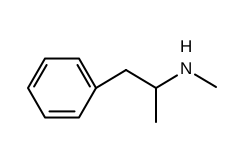
Methamphetamine was first synthesized in 1893 by the Japanese chemist Nagai Nagayoshi, and produced in crystal form by Akira Ogata in 1919. For decades it stayed a curiosity: a small molecule with no cultural container around it, no ritual, no accumulated knowledge about how to live with it. Just a compound, waiting for a use.
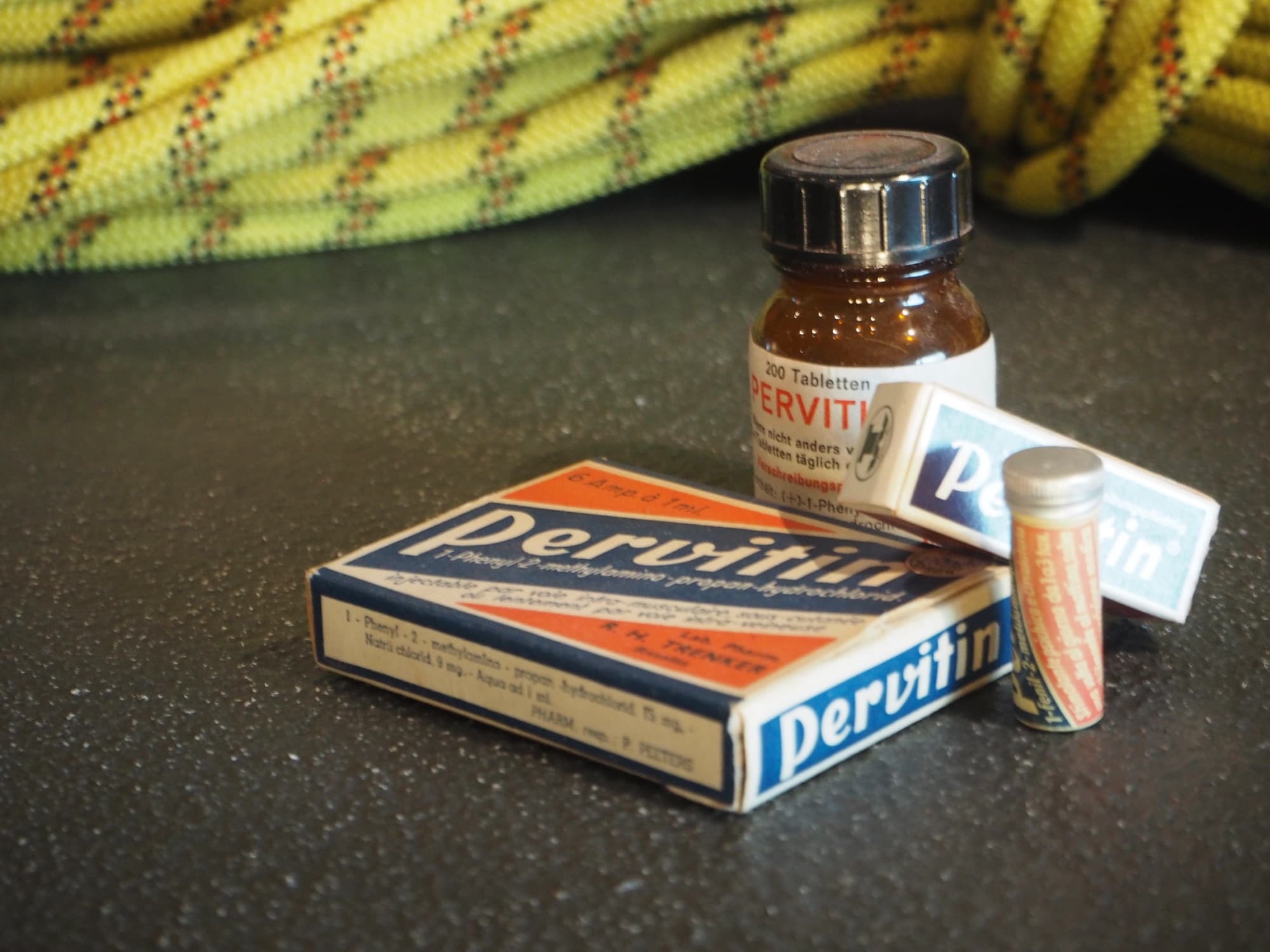
War found the use. Germany branded it Pervitin in 1938, and the Wehrmacht shipped over 35 million tablets to its soldiers in the spring of 1940 alone, fueling the Blitzkrieg with a pill the troops called tank chocolate. Japan gave it to pilots and factory workers, then watched the surplus pour into civilian life after the surrender and produce the first meth epidemic in history. The molecule never went back on the shelf: biker labs, super labs, and the modern street supply are the long tail of a military logistics program.
The reason this history belongs here is what it does to the story you carry about yourself. The thing that has a hold on you was engineered to push a nervous system past its own limits, pressure-tested on soldiers, and sold on to everyone else. Your losing battle with it is not a character flaw.
Ibogaine aftercare is the best way to ensure long-term success
Citations (7)
[20] Koenig X, Hilber K (2015). The Anti-Addiction Drug Ibogaine and the Heart: A Delicate Relation. Molecules, 20(2), 2208–2228. Read the source →
Review of ibogaine cardiac risk, including QT prolongation and arrhythmia. Documents a fatality in a 52-year-old man with a 20-year history of alcohol use disorder in whom postmortem examination found hepatic cirrhosis and steatosis alongside coronary artery sclerosis, supporting pre-existing liver disease as a significant risk factor and pre-treatment liver function testing as essential screening.
[35] Sulzer D, Sonders MS, Poulsen NW, Galli A (2005). Mechanisms of neurotransmitter release by amphetamines: a review. Progress in Neurobiology, 75(6), 406–433. Read the source →
Amphetamines, including methamphetamine, are the only widely used class of drugs that release dopamine directly rather than blocking its reuptake: they enter the neuron through the dopamine transporter, displace dopamine from its storage vesicles, and drive it back out through the transporter in reverse.
[36] Volkow ND, Chang L, Wang GJ, Fowler JS, Franceschi D, Sedler M, Gatley SJ, Miller E, Hitzemann R, Ding YS, Logan J (2001). Loss of dopamine transporters in methamphetamine abusers recovers with protracted abstinence. The Journal of Neuroscience, 21(23), 9414–9418. Read the source →
PET imaging of five methamphetamine users scanned in early abstinence (about 3 months) and again after protracted abstinence (about 14 months on average). Striatal dopamine transporter levels, which are significantly reduced in methamphetamine users, recovered substantially with sustained abstinence. Performance on motor and memory tests did not show comparable recovery over the same interval. A small sample, so a signal rather than a verdict.
[37] Zorick T, Nestor L, Miotto K, Sugar C, Hellemann G, Scanlon G, Rawson R, London ED (2010). Withdrawal symptoms in abstinent methamphetamine-dependent subjects. Addiction, 105(10), 1809–1818. Read the source →
Prospective observation of methamphetamine-dependent adults through monitored abstinence. Withdrawal symptoms were most intense during the first week, depressive symptoms did not approach healthy-control levels until about four weeks in, and craving did not decrease significantly until the second week, persisting at reduced levels through at least week five.
[38] Haning W, Goebert D (2007). Electrocardiographic abnormalities in methamphetamine abusers. Addiction, 102(Suppl 1), 70–75. Read the source →
Electrocardiograms from 158 adults with methamphetamine dependence across five US sites. 27.2% had a QTc interval longer than 440 ms, the first demonstration of clinically significant QTc prolongation in a methamphetamine-using population. Relevant to ibogaine screening because ibogaine also prolongs the QT interval.
[39] Glick SD, Gallagher CA, Hough LB, Rossman KL, Maisonneuve IM (1992). Differential effects of ibogaine pretreatment on brain levels of morphine and (+)-amphetamine. Brain Research, 588(1), 173–176. Read the source →
In rats, ibogaine given 19 hours before amphetamine significantly increased brain concentrations of amphetamine, suggesting ibogaine inhibits an amphetamine-metabolizing enzyme. Preclinical (animal) evidence, and a direct reason to keep ibogaine and methamphetamine far apart in time.
[40] Maisonneuve IM, Keller RW Jr, Glick SD (1992). Interactions of ibogaine and D-amphetamine: in vivo microdialysis and motor behavior in rats. Brain Research, 579(1), 87–92. Read the source →
In rats, ibogaine pretreatment potentiated amphetamine-induced increases in extracellular dopamine in the nucleus accumbens and striatum and enhanced amphetamine-induced motor activity. Preclinical (animal) evidence that the two compounds amplify each other rather than cancel out.