
Ibogaine treatment for nicotine dependence
Nicotine is one of the most tenacious dependencies there is, and it runs through the same nicotinic acetylcholine receptor that ibogaine acts on most directly. That overlap is why ibogaine is interesting for smoking and vaping. It is also why we are careful not to oversell it: the human evidence is still early, and we would rather tell you exactly where it stands than promise you a cure.
Medical care connected to the program is provided by licensed medical professionals under their own licenses. See our medical disclaimer.
In 2024, the share of American adults who smoke cigarettes dropped below 10 percent for the first time on record, about 25 million people. The number keeps falling because people keep quitting. What it hides is how many of them quit over and over, because nicotine is one of the hardest holds to break.²⁴
If you have tried to quit before, more than once, and it did not stick, you already know the thing the statistics tiptoe around. Nicotine is not a habit you white-knuckle your way out of. It rewires the brain's reward system faster and more thoroughly than almost anything else people get hooked on.
This is not a character flaw. It is pharmacology, and it is culture, and it is ritual. Nicotine locks onto a specific receptor in the brain, and it quietly builds itself into the rhythm of your day. Ibogaine breaks both: the hold at the receptor, and the loop that keeps you reaching for the next one.
“People will come through something enormous, get off heroin, and still not be able to put down the cigarettes. That tells you how deep nicotine goes.”
Charles D. Johnston, Co-Founder, Nekawa
How ibogaine treatment for nicotine works at Nekawa
Ibogaine acts as a non-competitive blocker at the α3β4 nicotinic receptor, and it does so more strongly than at most of its other targets.²⁵ Its long-lasting metabolite, noribogaine, does the same, and in animal studies noribogaine reduced nicotine self-administration about as much as varenicline, the prescription drug approved to help people stop smoking.²⁶ That receptor sits at the convergence point for a lot of dependencies, which is why the same molecule keeps turning up across opioids, alcohol, stimulants, and nicotine.
We will be straight about the limits. The strongest evidence for ibogaine and nicotine is still preclinical, in animals, and ibogaine's own results on nicotine specifically have been mixed, with the stronger signal coming from noribogaine.²⁷ There is no completed human smoking-cessation trial. What we can say honestly is that the mechanism is real and well studied, and that the people who come to us for nicotine are usually arriving after everything else has failed.
So the work is not only chemical. Ibogaine opens a window where the craving goes quiet, and what matters is what you build in that window. The preparation before the session, and the integration after it, are where a quit attempt actually becomes staying quit. How ibogaine works →

Why nicotine is so hard to put down
Nicotine reaches the brain within seconds of a puff and binds to nicotinic acetylcholine receptors, part of the signaling system your body runs on anyway. On the reward pathway, that binding releases dopamine, the quick, mild lift a cigarette or a vape delivers. Because nicotine clears fast, the receptor is asking again within the hour, which is how smoking settles into a tight, all-day loop.
Over time the brain builds more of these receptors to keep up, and the baseline itself starts to depend on nicotine. Going without it brings restlessness, irritability, trouble concentrating, and a craving that does not wait its turn. The physical side is milder than opioid withdrawal, but the craving is relentless, and it is the craving, not the discomfort, that ends most quit attempts.
And nicotine was never only brain chemistry. It has been sold to us for a century as sophistication, calm, rebellion, and belonging, and it almost always arrives socially: a cigarette bummed outside a bar, a vape passed around a table, the thing your parents or your friends did. It threads itself into the ordinary furniture of a day until it feels less like a drug and more like punctuation. That is what makes it so hard to shake, and why willpower alone so rarely does it.
Underneath all of it, though, sits one receptor: the α3β4 nicotinic receptor, concentrated in a small brain circuit that sets how hard a drug pulls at you. That is not a detail we mention for color. It is the same receptor ibogaine acts on, and it is the reason ibogaine is worth talking about here at all. If you want the receptor story in more depth, read more
One receptor, pulled two ways
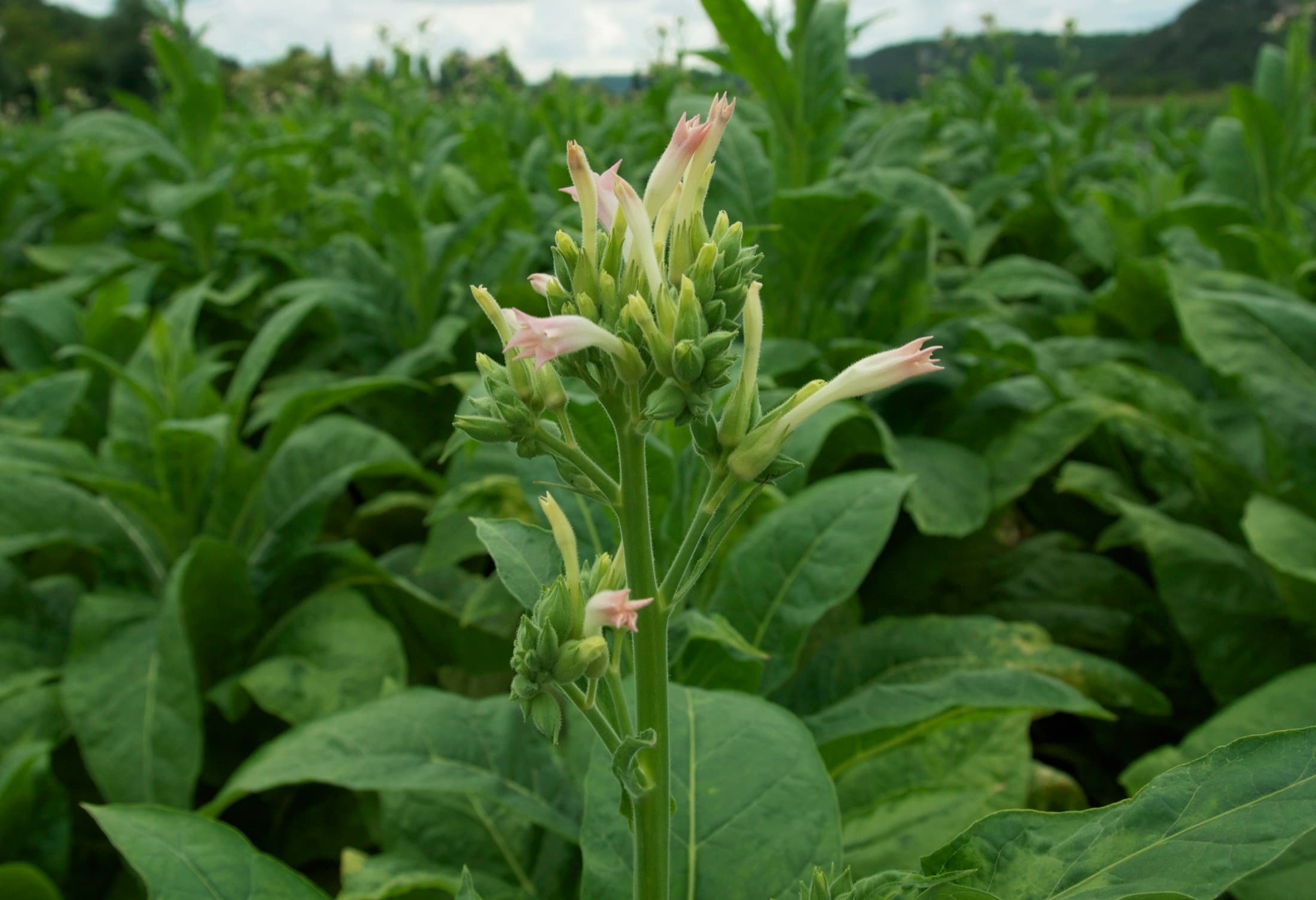
Tobacco, Nicotiana tabacum, is a striking plant, and people have had a far older and more complicated relationship with it than the cigarette suggests. What the modern product distilled out of it is nicotine, the molecule that reaches the brain in seconds and switches on the nicotinic acetylcholine receptor.
Ibogaine works on that very same receptor, from the other direction. Where nicotine switches it on, ibogaine and its long-lasting metabolite noribogaine block it. The two molecules below meet at the same lock, and that overlap is the whole reason ibogaine is worth discussing for nicotine at all.
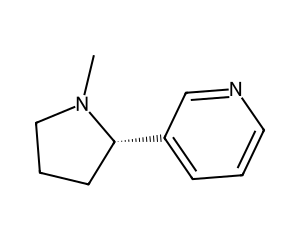
Nicotine
The agonist. It binds the α3β4 nicotinic receptor and switches it on, releasing the quick hit of dopamine that keeps the loop running.
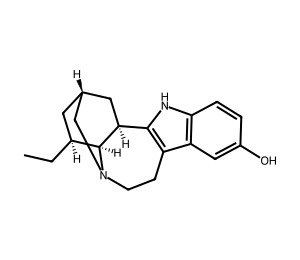
Noribogaine
The blocker. Ibogaine's long-lasting metabolite is a non-competitive antagonist at the same receptor, and in animal studies it cut nicotine self-administration about as much as varenicline.
Getting clear of nicotine before your ibogaine treatment
Getting Clear

What's included in your program
- Natural ibogaine treatment with spiritual guides and medical oversight
- Preparation and integration support with psychedelic-experienced psychologists
- A structured plan for getting fully clear of nicotine before the session
- Pre-treatment Ayurvedic cleansing protocol (sweat, colonics, nutrition, exercise)
- Traditional plant medicine as part of getting clear, for those who want it
- Post-treatment integration support for months, not days, during the Window of Wonder (WoW)
- Accommodations at our rainforest center for the full program, with nature immersion: rainforest, ocean, and mountain

Suggested Programs
Nicotine on its own does not need the long detox runway that opioids or alcohol do, so the question is less about clearing time and more about giving the reset, and the integration after it, room to hold. Most people who come to us for nicotine fit one of these.
28 days
28-Day Program
A complete reset in four weeks: getting fully clear, the session, and the first stretch of integration where new routines start to take.
Learn more →6, 8 or 12 weeks
Advanced Program
Room to get fully clear, do the session, and then give the reset real time to hold, with the deeper integration that decides whether a quit sticks in the weeks after. Available in 6, 8, or 12-week formats.
Learn more →

How ibogaine addresses this substance
Ibogaine works across four neurological and psychological dimensions, each specific to how this substance affects the brain.
Receptor Reset
Nicotine spends years driving the α3β4 nicotinic receptor. Ibogaine acts directly on that receptor, letting an over-adapted system settle back toward where it started, instead of feeding it a cleaner dose of the same thing.
Craving Interruption
The urge is what ends most quit attempts, not the physical symptoms. Ibogaine quiets that loop at the neurological level, and most students describe a stretch afterward where the craving simply is not running their day.
Reward Recalibration
Smoking hijacks the brain's reward signal, so ordinary things start to feel flat without it. Ibogaine helps recalibrate that signal, so coffee, food, and a normal morning stop feeling incomplete without a cigarette.
Neural Repair
Ibogaine stimulates growth factors that help the brain recover from dependency. We pair the session with nutrition, rest, and integration so that repair has a chance to hold.
In its older form, tobacco is medicine for getting clear
It is not that you do not smoke tobacco. You use it to cleanse, not to get high, and then you take it to purge. You take it to clear the energy. You take it to establish a relationship. It is nothing like modern cigarettes and vapes.
There is an obvious question on a page about quitting nicotine: why is there a section here that speaks well of tobacco? The answer is that the cigarette and the plant are near strangers. In many traditional lineages, tobacco is treated as a serious plant medicine, taken not to soothe but to purge, to heal, to clear the body and settle the mind before deeper work. It is used with intention, in a specific moment, and then put down.
One form of this is Rapé (pronounced ha-paay), a finely ground tobacco preparation blown through the nose. It is bracing, not casual, and its purpose is to clear you out and bring you into the present, exactly the kind of getting-clear that makes sense before an ibogaine treatment. Used this way, tobacco is a tool for stepping down and letting go, not a habit to feed. That distinction, medicine used with intention versus a compulsion fed all day, is the whole difference.
We hold this honestly. We are not telling anyone to take up tobacco, and traditional plant medicine is part of the tradition here for those who want it, not a prescription. For a lot of people, meeting tobacco in this older form quietly reframes the substance that has had a grip on them, and that reframing turns out to be part of getting free of it.
Ibogaine aftercare is the best way to ensure long-term success

Citations (4)
[24] Centers for Disease Control and Prevention (CDC), National Center for Health Statistics (2024). Current Cigarette Smoking Among Adults in the United States. National Health Interview Survey, 2024 (National Center for Health Statistics). Read the source →
In 2024, about 9.9% of U.S. adults, roughly 25 million people, currently smoked cigarettes. It was the first year the adult smoking rate fell below 10% since national surveillance began, down from 10.8% in 2023.
[25] Glick SD, Maisonneuve IM, Kitchen BA, Fleck MW (2002). Antagonism of alpha 3 beta 4 nicotinic receptors as a strategy to reduce opioid and stimulant self-administration. European Journal of Pharmacology, 438(1–2), 99–105. Read the source →
Ibogaine and its analogs act as antagonists at α3β4 nicotinic acetylcholine receptors, and ibogaine is a more potent antagonist at α3β4 than at NMDA, 5-HT3, or α4β2 receptors. The paper proposes α3β4 antagonism as a strategy to reduce self-administration of several drugs of abuse.
[26] Chang Q, Hanania T, Mash DC, Maillet EL (2015). Noribogaine reduces nicotine self-administration in rats. Journal of Psychopharmacology, 29(6), 704–711. Read the source →
Noribogaine, ibogaine's long-acting metabolite, dose-dependently reduced nicotine self-administration in rats, with an efficacy comparable to varenicline, an approved smoking-cessation medication. Preclinical (animal) evidence.
[27] Maisonneuve IM, Mann GL, Deibel CR, Glick SD (1997). Ibogaine and the dopaminergic response to nicotine. Psychopharmacology, 129(3), 249–256. Read the source →
Pretreatment with ibogaine attenuated the rise in extracellular dopamine produced by nicotine in rats, suggesting ibogaine can blunt nicotine's rewarding signal. Ibogaine's behavioral effects on nicotine in other studies were mixed. Preclinical.