By Charles Johnston · October 11, 2026
Who gets to own ibogaine? Texas's $50 million, patents and Gabon
Chapters (9)
The Nekawa Report · Editorial.
The video above is the full conversation from The Nekawa Report, with DJ asking the questions. You can also listen to it or read the transcript. What follows is the same argument in writing, with the reporting and research behind it.
Ibogaine is getting more attention from governments and drug companies than at any point in its history. Texas has put money on the table. The federal government has offered to match it. The FDA is asking how ibogaine trials should be designed. Drug developers are filing patents on ibogaine-like molecules.
If you are someone hoping ibogaine becomes a real, recognized medicine, that sounds like progress. Some of it is. But underneath the headlines sits a question almost nobody is asking out loud: who gets to own ibogaine? Who profits if it becomes a medicine, who decides what it looks like, and who gets left out?
In this edition, DJ put three questions to me. Here are my answers, and the sources behind them.
1. Texas set aside $50 million. How much has been spent?
As far as anyone can confirm, none of it.
When Texas passed Senate Bill 2308 in 2025 and set aside $50 million for ibogaine clinical trials, it was a real turning point. Nobody outside the small group working on it saw it coming, and it pulled ibogaine into mainstream conversation overnight.
But the money came with a condition. The state may not spend a dollar until someone outside the state puts up a matching amount, and any proposal has to show it can fully match state funding (Rowland, 2026).
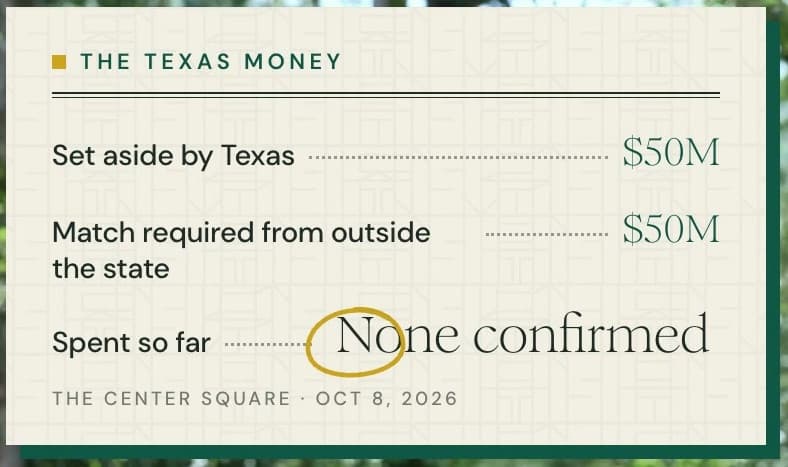
No drug company stepped forward with a qualifying proposal. Texas named UTHealth Houston to lead a consortium in December 2025, with the University of Texas Medical Branch and about a dozen other institutions involved. Yet the state's own ibogaine page says the plans it received so far "do not meet the requirements" of the law, including the rules on matching funds and on how revenue from any resulting intellectual property is shared (Texas HHSC, 2026).
Then, in April 2026, the federal government offered to step in. An executive order directed the Department of Health and Human Services to put at least $50 million toward matching state psychedelic research, and that money now runs through a program at ARPA-H, the federal health research agency. None of that federal money has been spent either (Rowland, 2026).
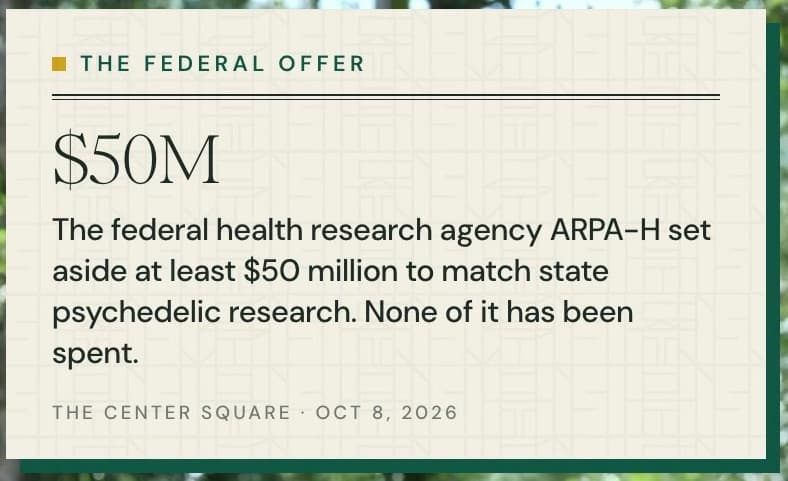
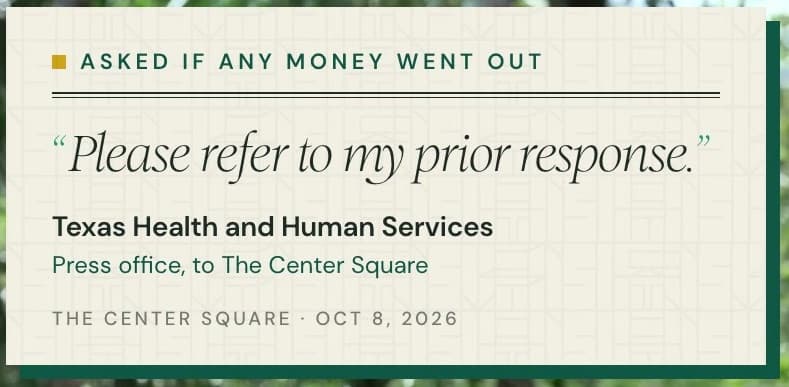
When a reporter asked whether a contract had been signed or any money paid out, the state's press office replied with one line.
So there are designated sites, there are plans, and there are press releases. There are no ibogaine trials running in Texas yet, and we are still a long way from them.
It is also worth putting the number in perspective. Bringing a new drug through every phase of clinical trials typically costs far more than $100 million, so even the full matched amount is a start, not a finish line.
Why drug companies stayed away
The simplest answer is patents.
Howard Lotsof, the man who noticed ibogaine's anti-addictive effects in the early 1960s, patented its use for interrupting opioid addiction. The patent was granted in 1985 (Lotsof, 1985), and it expired long ago. That means nobody can patent ibogaine itself anymore.
A company that wants exclusive rights has to patent something around the molecule instead: a formulation, a manufacturing process, a delivery method, a combination with therapy or with other compounds. That is legally complicated and commercially uncertain. If you are an investor deciding where to put $50 million, a molecule anyone can make is a hard sell.
It is also why the Texas law cares so much about intellectual property. Which brings us to a detail I will come back to at the end: the law reserves not less than 20 percent of the revenue from that intellectual property for the state of Texas (Tex. Health & Safety Code § 491.060).
2. A new study found ibogaine users reported the most side effects. What do I make of it?
On September 29, 2026, JAMA Network Open published a survey of US adults comparing what people reported after recent use of five substances: psilocybin, LSD, MDMA, ibogaine and 5-MeO-DMT (Simonsson et al., 2026).
Ibogaine came out with the highest rate of side effects. Among people who had used ibogaine in the past three months:
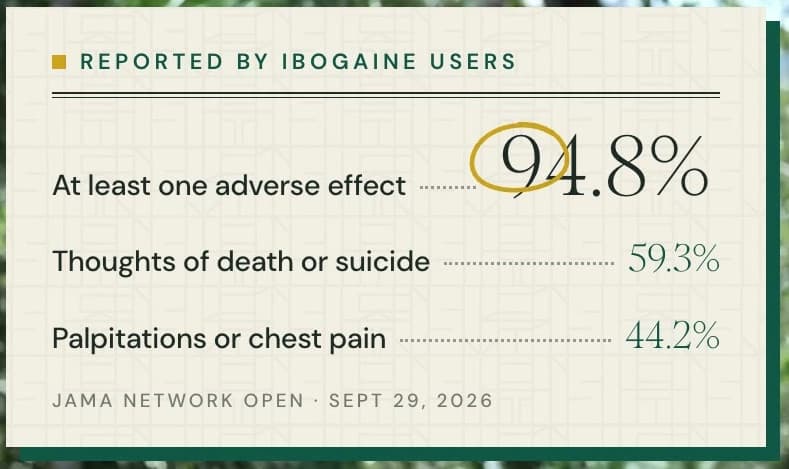
- 94.8% reported at least one adverse effect.
- 59.3% reported thoughts of death or suicide.
- 44.2% reported heart palpitations or chest pain or pressure.
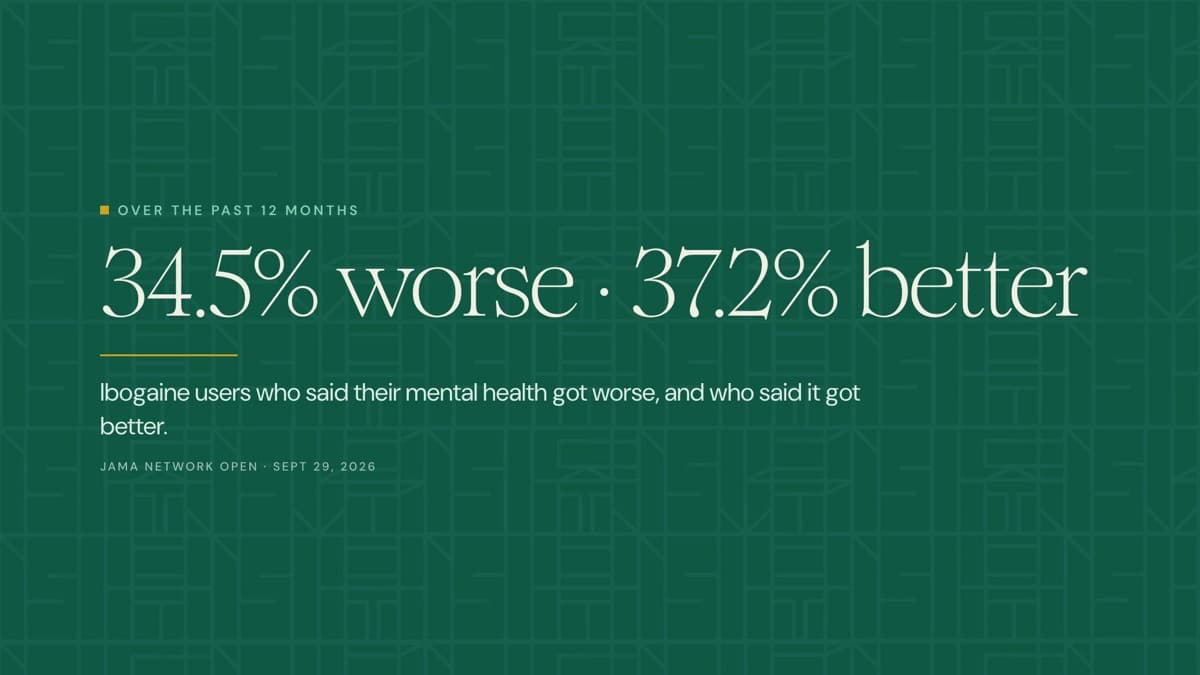
Looking back over the past year, about as many ibogaine users said their mental health got worse (34.5%) as said it got better (37.2%). Psychiatric News summed it up in its headline: people who used ibogaine or 5-MeO-DMT were as likely to report harms as help (Psychiatric News, 2026).
What the study can and can't tell us
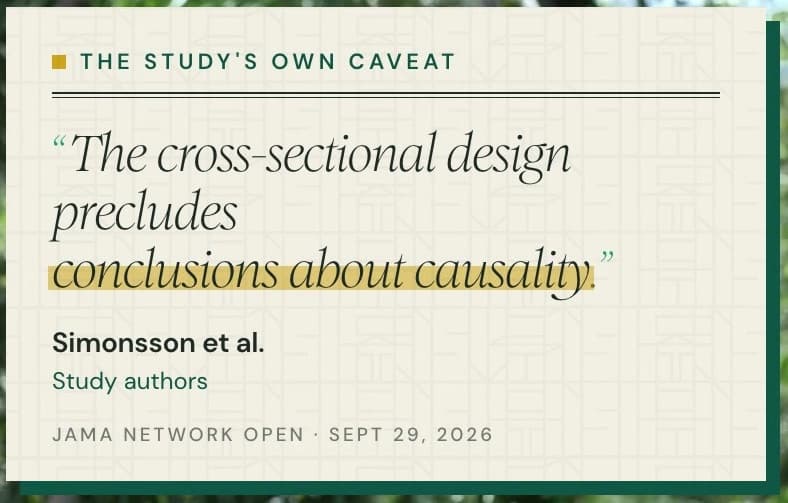
Before anyone runs with these numbers, read the authors' own limits. The ibogaine group was small: 74 people had used it in the past year and 59 in the past three months, so the margins of error are wide. The study captured people at one point in time, which means it cannot show that ibogaine caused any of these outcomes. People who seek out ibogaine may already have more psychiatric history or be using other substances. And the authors point out that a long, physically demanding experience like ibogaine may lead people to blame it for symptoms that were already there.
None of that makes the findings go away. The palpitation and chest pain numbers in particular line up with what we already know about ibogaine and the heart. Ibogaine can lengthen the QT interval, the time the heart takes to reset between beats, and that raises the risk of dangerous arrhythmias. Deaths have been reported (Koenig & Hilber, 2015). In a Dutch hospital study of 14 people with opioid use disorder, QT prolongation was common and some reached levels cardiologists consider dangerous (Knuijver et al., 2022). This is why honest cardiac screening and monitoring are not optional, wherever you go. Our page on whether ibogaine is safe goes deeper.
Why I'm not surprised
My honest reaction is that the research is finally getting more truthful. Ibogaine is not going to fix you in one night and send you home transformed. It is a complex, demanding medicine.
And I think a lot of the harm showing up in studies like this comes from how ibogaine is being done. Most of it happens fast. People fly in, take a large dose, and fly home a few days later, with none of the traditional elements and very little time to recover. From my own experience, it takes me a long time to come back after ibogaine. My mind is soft and open afterwards, and if I drop straight back into a stressful environment, or even an ordinary one, I struggle. That sensitivity is part of what makes the window after ibogaine valuable. It is also what makes rushing out of it risky. It is the reason our program runs 28 days instead of a long weekend.
I also know many facilitators who work with people in serious addiction, and many of them will tell you privately that relapse after ibogaine is common. That fits the research. Small observational studies report real drops in withdrawal and drug use after ibogaine treatment for opioid use disorder, but without comparison groups they cannot tell us how ibogaine stacks up against other treatments over time (Brown & Alper, 2018). The "80 or 90 percent cure rate" you sometimes hear was never backed by evidence.
A foundation, not a cure
"Ibogaine is not a cure for addiction. Ibogaine is a stepping stone. It's a foundation."
I believe ibogaine is the best way to begin overcoming addiction. But it is a beginning. After it comes the hard part: studying, reading, rebuilding how you think and live.
Here is the trap I see people fall into. They hope ibogaine will return them to who they were before the addiction. But who you were before is the person who started using in the first place. Going back there just sets you up to repeat it. Recovery means becoming someone new, not restoring an old version of yourself.
That is exactly what the iboga tradition is built around. Bwiti is, among other things, a teaching about how to think and how to live, down to simple principles like not making assumptions. Things that simple are rarely taught anywhere in our culture, not in psychology and not in most recovery programs. The tradition treats iboga as a teacher. A molecule given in a clinic with no teaching around it is a very different thing.
So what this study tells me is not that ibogaine is the answer, or that it is dangerous and should be abandoned. It tells me ibogaine is difficult, that it asks a lot of you, and that you need to be in a good place, with real support and plenty of time, for it to work.
3. Drug companies are building analogs without the trip or the heart risk. What's wrong with that?
Because ibogaine itself can't be patented, companies are developing analogs: molecules that resemble ibogaine, are derived from it, or are modified just enough to be new. A new molecule can be patented, and a patent brings years of exclusive sales.
Medscape's reporting on the field lists three ibogaine-like candidates in development (Medscape, 2026):
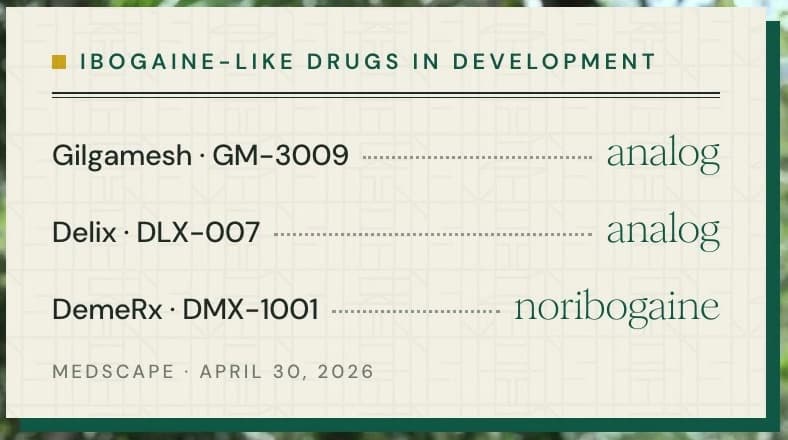
The stated goals are usually two. One is to remove the heart risk. The other, for some developers, is to remove the psychedelic experience. Researchers have been open about wanting to engineer "safer" versions of psychedelics that keep the anti-addictive effect without the hallucinogenic one (Peters & Olson, 2021).
I want to be fair here. If a molecule really did keep ibogaine's benefits without the cardiac danger, that would matter, and some people would be helped by it. But two things bother me.
First, "no heart risk" is a goal, not a fact. DemeRx's candidate is noribogaine, the compound your body turns ibogaine into, and noribogaine itself acts on the same heart channel that makes ibogaine risky. In a placebo-controlled trial in people with opioid dependence, noribogaine lengthened the QT interval in a dose-dependent way (Glue et al., 2016). Every new molecule will need to prove its safety the long way, in trials, before anyone can claim it.
Second, removing the experience removes the point. Ibogaine is the main alkaloid in iboga, a plant people have worked with as a spiritual medicine for generations.
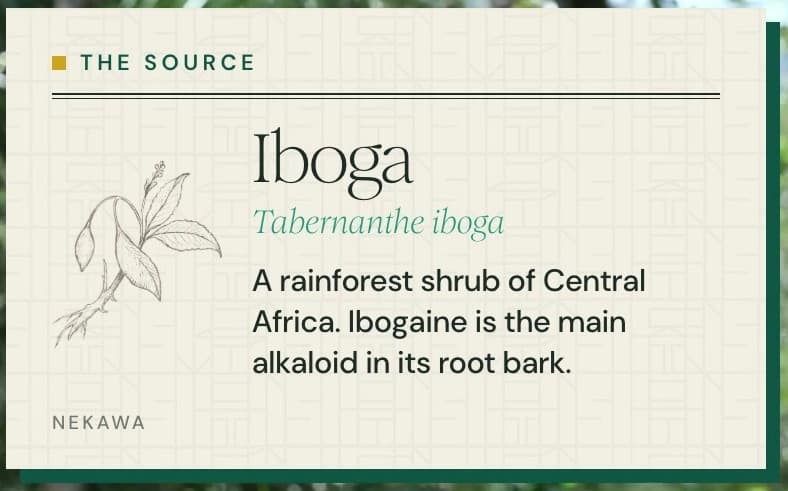
Building modified versions that strip out the very thing it does best seems backwards to me. Companies can frame it as safety or convenience, but the business logic is plain: a molecule that only you can sell and market. Maybe some of these drugs will help people. The medicine we already have, straight from nature, already works.
"It's really all just about money. It's business."
From opium to fentanyl
The history of opium is the clearest warning I know.
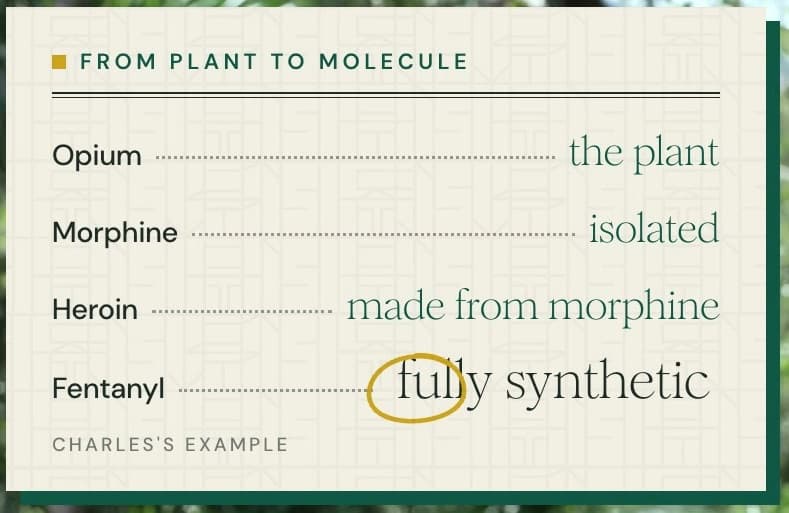
People used the opium poppy as medicine for thousands of years, for pain, coughs, sleeplessness and much more. Then we started isolating parts of it. Morphine came out of opium. Heroin was made from morphine. Each one began in medicine and then found its way to the street. Today we have fentanyl, carfentanil and a stream of research chemicals many times stronger than anything in the original plant, and people are dying from them in enormous numbers because underground markets saw the profit.
I am not saying ibogaine analogs will become the next fentanyl. They act on the brain very differently. What I am saying is that once a plant medicine is broken into proprietary molecules, the incentives change. Companies market, competitors copy, and versions start circulating well beyond anyone's control. I would rather we kept our focus on the plant, on tradition and on what is natural.
4. The FDA and tradition
On October 6, 2026, the FDA asked the public for input on how ibogaine clinical trials should be designed and kept safe (FDA, 2026). In that same notice, it said it was not seeking comments on religious, ceremonial or personal use.
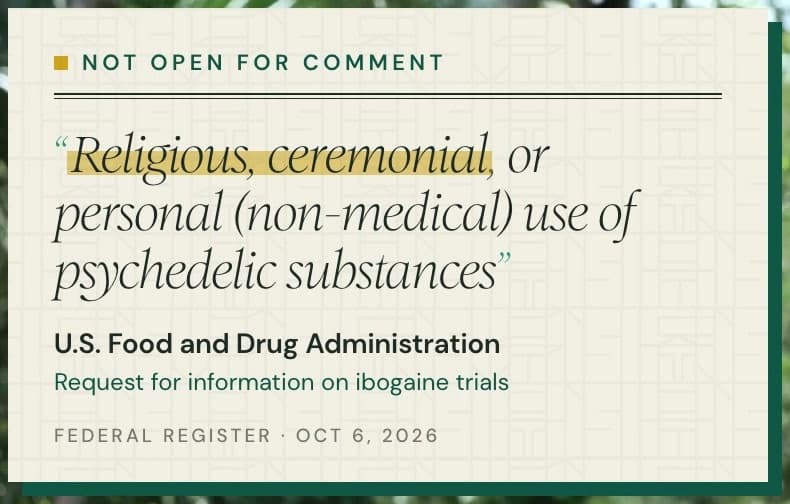
To be precise, that limits what the FDA wants to hear in this comment round. It is not a rule banning traditional elements from trials. In the video I put it more broadly than that, so I want to correct it here.
My view stays the same, though. Leaving tradition out of the conversation is a mistake. The traditional and spiritual setting is not decoration around ibogaine. It is how ibogaine has been used safely and meaningfully for generations. Design trials without it, and we will end up studying a pale copy of the real medicine and then wondering why the results disappoint.
5. What about Gabon?
Go back to that Texas law. It reserves at least 20 percent of the revenue from ibogaine intellectual property for the state of Texas. That is fine as far as it goes. But there is no share at all for Gabon, the country where iboga grows and where the knowledge of how to use it was kept alive.
"What about Gabon? What about the place where this medicine comes from?"
Gabon has noticed. In September 2026 it moved to ban the export of iboga and all its derivatives while it builds a national framework (Gabon24, 2026). Earlier in the year, it signed a decree asserting sovereignty over iboga, its derivatives and the traditional knowledge around it, and requiring benefit-sharing agreements for commercial use (Helfend, 2026).
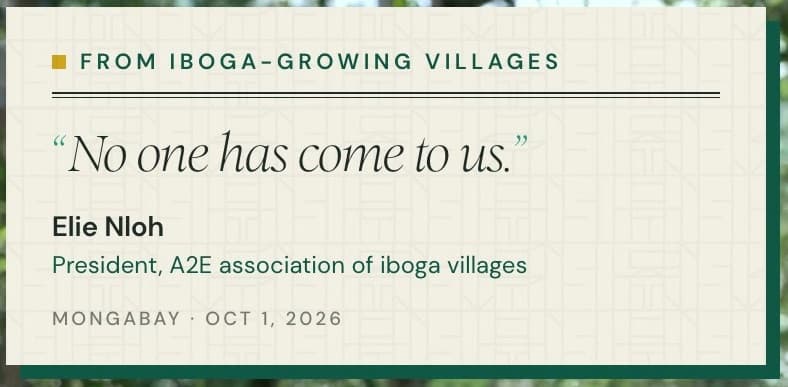
The people who grow iboga describe the same gap. The president of an association of iboga-growing villages told Mongabay:
Taking a people's medicine and their knowledge, turning it into private profit and sending little or nothing back has a name: biopiracy. I covered the money side of this in Who's getting rich off ibogaine?, and I think it is one of the biggest problems facing the whole field.
A better path is obvious to me. Invite Gabonese practitioners to teach and guide this process of bringing iboga into medicine, rather than giving them a token mention and doing everything ourselves. The current approach is not healthy, and I believe it will backfire.
6. What research supports and what remains uncertain
My opinions and the evidence are different things, so here is where each claim stands.
- The Texas money. It is documented that the funds are allocated and conditional on an outside match, and that no spending has been confirmed as of October 8, 2026 (Rowland, 2026). That could change, and we will report it if it does.
- The side-effect study. The numbers are real, but they come from a small group surveyed once, and they cannot show cause and effect (Simonsson et al., 2026).
- Heart risk. This one is well established. Ibogaine can prolong the QT interval and has been linked to deaths (Koenig & Hilber, 2015; Knuijver et al., 2022).
- Addiction outcomes. Observational studies are encouraging but have no comparison groups (Brown & Alper, 2018). High relapse without aftercare is what I and other practitioners see, not a measured rate.
- Analogs. None has yet been proven safer or as effective as ibogaine in humans. The claims are goals.
- Tradition. No clinical research compares outcomes in traditional settings with clinics. My belief that tradition and time make a difference comes from experience, not trials.
7. What this means if you're considering ibogaine
If you are thinking about ibogaine for yourself or someone you love, here is what I would take from all of this:
- Don't wait for Texas. Approved ibogaine treatment in the United States is still years away at best.
- Take the risks seriously. Insist on a real cardiac workup, including an ECG, a full medical and medication history, and monitoring during treatment.
- Plan for the time after. The days and weeks after ibogaine are when the real work starts. Ask any program what support looks like afterwards, and for how long.
- Be wary of quick fixes. That includes a three-day stay that promises a cure, and a future pill that promises the benefits without the experience.
- Ask where the medicine comes from, and whether anyone in Gabon benefits from what you pay.
If you want to talk it through with us, honestly and without pressure, connect with us: join an integration circle, schedule a call, or just let us know how you're doing.
And if you disagree with me, say so in the comments on YouTube. We need more discussion about ibogaine, not less.
Educational content only. Nothing here is medical advice. Ibogaine carries serious health risks, including heart risk, and is not legal everywhere. Speak with a qualified professional before making any health decision.
Related reading
- Who's getting rich off ibogaine? A response to the New York Post
- Ibogaine versus Iboga and the difference between plant and molecule
- Is ibogaine safe?
- What is ibogaine?
- Ibogaine research
- Why 28 days? Preparation, integration, and the jungle in ibogaine care
- The Nekawa Report playlist on YouTube
About the author
Charles D. Johnston is co-founder and lead teacher of Nekawa. After years of heroin and cocaine addiction, he went through ibogaine treatment in 2013 and helped launch six ibogaine projects in Mexico and Costa Rica before founding Nekawa in Brazil. He is initiated in Bwiti and continues training with Gabonese elders in Brazil and Gabon. He is the author of Facets of Ayahuasca (2018) and executive producer of Curandera (2025). Read his story.
References (15)
- Brown, T. K., & Alper, K. (2018). Treatment of opioid use disorder with ibogaine: Detoxification and drug use outcomes. The American Journal of Drug and Alcohol Abuse, 44(1), 24–36. https://doi.org/10.1080/00952990.2017.1320802
- Food and Drug Administration. (2026, October 6). Design and safety considerations for clinical trials involving ibogaine drug products; Request for information. Federal Register. https://www.federalregister.gov/documents/2026/10/06/2026-20427/design-and-safety-considerations-for-clinical-trials-involving-ibogaine-drug-products-request-for
- Gabon24. (2026, September 19). Gabon : l'État interdit formellement l'exportation de l'iboga et de tous ses dérivés. https://gabon24.tv/environnement/gabon-l-etat-interdit-formellement-l-exportation-de-l-iboga-et-de-tous-ses-derives
- Glue, P., Cape, G., Tunnicliff, D., Lockhart, M., Lam, F., Hung, N., ... Friedhoff, L. (2016). Ascending single-dose, double-blind, placebo-controlled safety study of noribogaine in opioid-dependent patients. Clinical Pharmacology in Drug Development, 5(6), 460–468. https://doi.org/10.1002/cpdd.254
- Helfend, M. (2026, October 1). Gabon, home to the medicinal plant behind ibogaine, wants a fairer share of its global boom. Mongabay. https://news.mongabay.com/2026/10/gabon-home-to-the-medicinal-plant-behind-ibogaine-wants-a-fairer-share-of-its-global-boom/
- Ibogaine for psychiatric illness: Federal policy push meets safety concerns. (2026, April 30). Medscape. https://www.medscape.com/viewarticle/ibogaine-psychiatric-illness-federal-policy-push-meets-2026a1000dvc
- Knuijver, T., Schellekens, A., Belgers, M., Donders, R., van Oosteren, T., Kramers, K., & Verkes, R. (2022). Safety of ibogaine administration in detoxification of opioid-dependent individuals: A descriptive open-label observational study. Addiction, 117(1), 118–128. https://doi.org/10.1111/add.15448
- Koenig, X., & Hilber, K. (2015). The anti-addiction drug ibogaine and the heart: A delicate relation. Molecules, 20(2), 2208–2228. https://doi.org/10.3390/molecules20022208
- Lotsof, H. S. (1985). Rapid method for interrupting the narcotic addiction syndrome (U.S. Patent No. 4,499,096). U.S. Patent and Trademark Office. https://patents.google.com/patent/US4499096A/en
- Peters, J., & Olson, D. E. (2021). Engineering safer psychedelics for treating addiction. Neuroscience Insights, 16, 26331055211033847. https://doi.org/10.1177/26331055211033847
- Psychiatric News. (2026, September 30). Adults who used ibogaine or 5-MeO-DMT as likely to report harms as help. https://alert.psychnews.org/adults-who-used-ibogaine-or-5-meo-dmt-as-likely-to-report-harms-as-help
- Rowland, B. (2026, October 8). Texas can't spend $50M for ibogaine trials. Feds may fill the gap. The Center Square. https://www.thecentersquare.com/national/article_37afc3c5-b85a-4982-b064-1758740fe359.html
- Simonsson, O., Bradley, M., Black, J. C., Rockhill, K. M., Monte, A. A., & Hendricks, P. S. (2026). Adverse health outcomes of psilocybin, LSD, MDMA, ibogaine, and 5-MeO-DMT. JAMA Network Open, 9(9), e2636756. https://doi.org/10.1001/jamanetworkopen.2026.36756
- Texas Health and Human Services Commission. (2026). Ibogaine clinical trials. https://www.hhs.texas.gov/services/mental-health-substance-use/mental-health-substance-use-resources/ibogaine-clinical-trials
- Texas Health and Safety Code § 491.060. Allocation of revenue attributable to intellectual property and other rights. https://law.justia.com/codes/texas/health-and-safety-code/title-6/subtitle-c/chapter-491/subchapter-b/section-491-060/
Transcript
Charles: They want to have a molecule that only they can sell and they can market so that they can make as much money as possible. But what about Gabon? What about the place where this medicine comes from? There's no allocation to them. Hi, this is Charles Johnston at Nekawa Ibogaine in Brazil providing today's Nekawa Report. And so today I want to talk about the current regulation efforts that are going on in the United States, the money that's happening, and what the reality is for those that are looking to do ibogaine in the future and who are hoping this medicine actually becomes a medicine. So I have with me today DJ, he's going to be helping me, asking some questions, and we're going to be discussing this in depth.
Charles: Enjoy!
DJ: All right, a recent article came out that said Texas set aside 50 million for ibogaine trials. How much has been spent?
Charles: So, Texas setting aside 50 million for ibogaine trials was revolutionary. It was something that no one expected except for those working on it, and it really brought ibogaine into the light. But the problem is is that that money was tied to the fact that they needed to raise another 50 million from outside of the state to actually allocate towards ibogaine clinical trials. Now, it's very likely that ibogaine clinical trials are going to cost way more than a hundred million dollars. Most drug trials cost billions or more, so that money is a small number in regards to actually researching ibogaine.
Charles: But no one stepped up even for the matching grant. There was no drug companies. No one was interested in putting forward 50 million more dollars. So, the United States government said, "Well, we'll do it. They're going to put forward the 50 million dollars," but we still don't have anything. That happened in 2025. We have no money been allocated yet. They've designated sites. They've talked about what they're going to do. But still, we are far away from actually beginning any ibogaine trials, and so we'll see. And why don't drug developers want to be part of this? Well, it's because ibogaine already has some expired patents.
Charles: It got patented back in 1980s by Howard Lotsof, the guy who discovered its anti-addictive effects in the '60s. So, ibogaine's been around for a while, but because the patent has expired, no one can patent ibogaine itself. They have to patent formulations, or they have to patent processes, like combined with therapy or combined with some amino acids or something like that. And so, it becomes a little bit more complicated in patenting these molecules and, you know, legally complex. So, we're still waiting.
DJ: All right, let's talk about the safety numbers. A new study in JAMA Network Open found ibogaine users reported the most side effects of five psychedelics, 94.8%. What's your reaction?
Charles: Yeah, exactly. Over 90% of people who experienced ibogaine had side effects, and over 50% of those were actually unpleasant, adverse side effects. I think it's said that somewhere in the range of 30 to 35% of people attributed harm to the ibogaine experience as much as 30 to 35% attributed helpfulness to the ibogaine experience. So what we see is not this ibogaine is going to fix you, it's going to show you you're a child of God, it's all of these great things, but ibogaine is a very complex medicine. It's a very complicated medicine, and I think a lot of these issues that are showing up is the fact that we're doing ibogaine in such a poor way.
Charles: We're not incorporating any of the traditional elements, and people are having this experience very quickly, and then they're going right back home. And what I know from my own personal experiences with ibogaine is it takes me a long time to recover, and if I end up back in an environment that's challenging or just a regular environment, I become challenged because I'm so sensitive. My mind is so soft that it prevents a lot of problems. So what we're seeing is now the research is being more honest and telling us that, yeah, this is not an 80 or 90% cure rate, and in fact there's plenty of practitioners, facilitators I know that provide ibogaine to people who are going through substance abuse disorder and other very harrowing conditions, and many of them will tell you that the relapse rates, the rates of using again, are incredibly high.
Charles: Why? Because ibogaine is not a cure for addiction. Ibogaine is a stepping stone. It's a foundation. It's a place that you begin your journey, and if you don't start really understanding what you have to do with your life, which is inherent in any addiction treatment, you're not going to get better. I do believe ibogaine is the best way to start your process to overcoming addiction, but then you've got to do a lot of intense work. You've got to study and read and reeducate yourself because this idea of being recovered, of going back to the way you were before, is false. The way you were before was fucked up already.
Charles: That's why you started using drugs in the first place. So if you think ibogaine is going to take you back to a pre-addicted state, well guess what's going to happen? That's the state that got you an addiction in the first place. You have to start over. You have to learn more and understand more. So what these studies are telling us that are showing that there's harm is that ibogaine is not the answer, but that it's a much more complicated process, and we have to start thinking about ibogaine as a teacher for getting out of addiction. That's why there's indigenous use and there's a whole religious tradition based on the use of iboga and ibogaine that teaches people how to think.
Charles: It's all about how to think and operate in the world, and some of that has to do with very simple concepts like don't make assumptions. Very simple, but these things are not inherently taught in our world today, not in psychology, not in recovery, not anywhere unless you end up studying and reading books. So that's the thing I want to touch on with that is that this study is showing us that ibogaine is challenging and it's difficult, and you need to be in a really good place and have a lot of time if you want to make it work for you.
DJ: All right, drug companies are building analogs that take out the trip and the heart risk. What is wrong with that?
Charles: So, because ibogaine has this complicated patent issue, many drug companies, Gilgamesh and DemeRx and others are developing analogs. And what that means is it's ibogaine-like, basically. They're molecules that are similar to ibogaine, derived from ibogaine, or added something to, to make it a little bit different, so then they can patent it and have a 10-year, however many years, exclusivity on selling that drug. And a lot of them are claiming that the reason why they're doing this is to reduce the cardiac concern. They want to eliminate cardiotoxicity that comes with using ibogaine. Some of them say they want to get rid of the psychedelic experience that comes with ibogaine.
Charles: But doesn't that sound a little off? Ibogaine is a spiritual medicine. It's used in the plant iboga. It's part of that plant. It's the main part of that plant that's been used for many generations by people as a spiritual healing tool. And the fact that we want to make mutant versions of that, that get rid of the thing that it does best, is just absurd. And so they may claim it's because we want to do this or that, but it's really all just about money. It's business. They want to have a molecule that only they can sell and they can market so that they can make as much money as possible. Yes, maybe it'll be helpful, but in reality, this medicine already works.
Charles: It's already incredibly helpful. It already comes directly from nature, ready for us to consume and heal ourselves. So why are we trying to make a bunch of variations of it? To me, it's a bit crazy. And what I think the problem with the analogs is that if we look at, I'll use an example. This is a very potent example. If we look at the medicine that is opium, which has been used in human history for thousands of years to deal with respiratory issues, to deal with fatigue, to deal with pain, sleeplessness, a wide range as a medicinal medicine or as a medicinal plant. It's an incredible plant. But we then started to extract out parts of it.
Charles: We started to extract out morphine and then we extracted out heroin. We made heroin from morphine. And so we started to create these isolated molecules. And what did we see happen? First, they were used in medicine. But then they started getting used illicitly because they had certain effects. And then now what do we see? We see fentanyl. We see cyclo morphine. We see carfentanil. We see all these research chemicals that are 10, 20, 100,000 times stronger than the original thing. And what's the world, what's going on in society? People are dropping like flies. They're dying and dying and dying because there are markets that are underground, black markets that see the advantage of selling these things illegally and start to sell them.
Charles: We're going to see the same thing happen with the ibogaine analogs is people are going to start marketing them and selling them and trying to get them into people's hands. And this rush of molecules that are going to spread out into the market. And it's just a massive clusterfuck, to be honest with you. It's a major problem. And I think if we could get our focus back, back on tradition, back on nature, back on what is natural, we will be much better off. And so that's where I think we have to start bringing in the natural. I know the FDA recently said that they didn't want to have any and they asked for comments about ibogaine and ibogaine clinic design.
Charles: And they said, we don't want anything to deal with spiritual or traditional elements. That's an error. The FDA absolutely should bring in traditional and spiritual elements, because without it, we end up with something that is a pale comparison of the actual medicine and its use. So I think that's important. The other thing I want to point out is that, for instance, with Texas and its funds to develop ibogaine into a medicine, Texas allocated that they're going to receive 20% of revenue profits that come from this development of ibogaine as a medicine. But what about Gabon? What about the place where this medicine comes from?
Charles: There's no allocation to them. And recently Gabon said that they wanted to ban the export of ibogaine and all its derivatives. This happened a few weeks ago, but they also said it years ago that they want to put a complete stopping to this whole process where people are stealing and taking their medicine and turning it into their own benefit. This is biopiracy and it's very problematic. And I think that the better thing would be to have the Gabonese come and teach us and guide us through this process of instituting iboga as a medicine, rather than the way that we're doing, which is kind of we're giving them some credit, very, very little, and then we're doing it all ourselves.
Charles: It's not a healthy approach, and I think it's going to end up backfiring, to be honest. All right, so that's my Nekawa Report. A few things about ibogaine, what's going on in the news right now. Thank you for joining us today. Thank you, DJ, for having me. And we will continue to report on news in the ibogaine world, the psychedelic space, and addiction. And please, if you disagree with me, say something. Comment. I love it. Let's battle. Because we need more discussion about this. We need more dialogue. And if you liked what I had to say, please share it. Repost. Like it. Save it. Let the algorithm know that this is valuable content so that it can get spread to more and more people.
Charles: And please understand that, yes, I run an ibogaine program, but I run a very small ibogaine program, and my goal is education. I want to educate as many people as possible and help the people that are there. There are thousands of people in Africa there working with this medicine who are not getting any gain or benefit from this huge movement that's happening. And we need them to be included more. We need to uplift our brothers and sisters that are across the ocean and across the world so that they too can have healthy lives, so that they too can take care of their families. This is so important.
Charles: So thanks for joining today. Charles Johnston again, and I will see you later.


